
Contents
- The Instrument for the Apocalypse
- The Campfire Test
- How is this possible?!
- A Confession: I published the answer in 2015 and didn’t notice
- The Case of the Missing Fundamental
- Why the Small Basses Sounded Bigger and Bassier
- Stages One and Two: a small guitar body is already a high-pass filter
- Stage Three — the nylon core: the harmonic generator, and the whole game
- Inharmonicity: the single biggest failure mode of the traditional acoustic bass guitar
- Spectral centroid, or why your bass sounds higher than it is
- Summary: three concepts, in one breath
- Short scale: accidental gifts
- Small body: the ridiculous one turns out to be right
- No, you can’t just change the strings and fix everything
- Part Two: Accidents of History, and How the Acoustic Bass Guitar Was Doomed at Birth
- The zeroth accident: the customer was never a bass player
- The first accident: the pickup chose the string
- The second accident: the arbitrary 34” scale, and the shrug behind it
- And then the acoustic builders copied all of it
- The third accident: the costume department
- Good unplugged: equals bad plugged
- Part Three: Unintended Improvements:
- Number One: Finally we get the right strings.
- Taylor: Andy Powers stumbles over the truth
- Martin: second to market, and over the line
- Kala: the accident that went furthest
- And here is where all three stop
- Improvement Number Two: The magic of the Turbo Tail.
- What they got right by luck, and never mention
- Technical Difficulties
- You Will Almost Certainly Have to Change Your Technique
- In Summary and Snark.
- Are There No Standards Anymore? No, There Never Were Any Standards
- Everyone else solved this
- Perceived loudness is psychological, and it has standards too
- So here is the standard
- The point of a standard
- The Future of Acoustic Bass
- The instrument
- What the instruments said back
- The measurements
- The FreeBass Standard
- Feral acoustic bass
- Strings
- Technique
- The book
The Instrument for the Apocalypse
I have spent my entire adult life looking for one thing: an instrument I can carry on my back, walk into any room or up a trail, unzip from its case, and make the paintings rattle on the wall or the asses around the campfire get up and shake. No amp. No cord.
Not a bass that implies bass. Not an instrument whose only real virtue is that your left hand already knows where to go — same positions, same shapes, same muscle memory — so you can pretend to play the right notes while the guitar player drowns you out and your oversized box puts out more string noise than root notes. I needed an instrument that does the actual job of a bass, which is to hold the ONE — the root, the tonic, the low fundamental that tells every other instrument where home is — and to do it with enough physical authority that people feel it in their chest before they hear it in their ears. I wanted a bass that can still walk the blues when the power grid goes down at the end of civilization — an instrument for the apocalypse.
Portable, unambiguous BASS with no amp. I’ll settle for nothing less.
The upright does this. It also weighs as much as a refrigerator, barely fits in a car, and requires you to plan your whole life around getting it through doorways.

The Mexican guitarrón does this marvelously, which is why I’ve played one for nearly two decades. It’s the loudest portable unamplified bass instrument I have ever stood next to, and I’ve stood next to a lot of them. More on that underappreciated instrument later.

The upright and the guitarrón work. Neither of them is the instrument I wanted when I began this quest. Neither fully satisfies my cravings.
And then there is the acoustic bass guitar. The thing that looks like a dreadnought that ate a P-Bass: an acoustic guitar body with four strings. The thing that has been sold to hopeful bassists since 1972 with the promise of “acoustic bass” in the name. The thing that, with vanishingly few exceptions, produces a sound I can only describe as clicky, clacky, stringy, brassy, bright.
Thin.
Hollow.
Quiet…
Everything a bass is not.
For decades we bassists accepted the conventional wisdom: that an acoustic bass guitar — one you could actually play like a bass guitar, loud enough and deep enough to hang with a few guitars, fiddles and mandolins around a campfire, or in an Irish pub, or against a polite banjo player at a bluegrass jam — was impossible. We all believed it couldn’t be done.
It’s just physics, we were told. The body can’t be big enough. And the evidence was on their side: huge-bodied attempts like the Taylor AB series and the Tacoma Thunderchief still failed the campfire test by any honest accounting. So most people gave up. A few intrepid builders kept at it, but if we’re honest, those still don’t sound like a bass, or they are still too quiet.
Stringy. Brassy. Thin. Click. Clang. Rattle. Bright. Fret buzz. String noise. Maybe some midrange cut.
Sparkle, yes…
Bass? No…
So I gave up too. I surrendered to the idea that if I wanted to play truly acoustically I was condemned to schlep the massive upright, or play the guitarrón and mourn the five lowest notes it doesn’t have and endure the high action that punishes you for every note it has.
I accepted what everyone on the message boards preached: that a usable acoustic bass guitar would have to be so large it would either be unplayable, or be an upright in disguise — in which case just play the fucking upright already.
I believed them.
Until a ukulele bass and a \$45 set of strings from Italy proved them wrong.
Yes: a U-Bass.
I want to explain why. Not with vibes. With physics. With cognitive science. And then I want to tell you how to build an ABG that doesn’t suck, because the answer turns out to be sitting in plain sight, but strewn about like puzzle pieces no one has yet bothered to put together. I’ll show you the pieces, how I found them, and why each is important.
The Campfire Test
I’ve owned lots of ABGs. Too many: an Ovation, a Tacoma Thunderchief and its budget spinoff, the Olympia. A Taylor AB-2, a Michael Kelly, a Gold Tone, a Washburn, a Guild, and others not worth mentioning. None of them could do the job they promised: pass the campfire test.
Since I keep saying “unplugged” and “loud enough,” I should say what I mean, because the benchmark matters.
The ultimate benchmark for every acoustic instrument is a well-trained human voice. That’s the thing every instrument in history was built to accompany, and a shocking number of modern guitars barely keep up with it.
I learned what “not loud enough” means the hard way, with the first acoustic bass guitar I ever owned. It was an Ovation, with the plastic round back like a casserole dish, and I bought it in Texas to join a folk-soul band — Ani DiFranco meets Joni Mitchell in her Shadows and Light period, two women singing in harmony, folk with a jazz edge — because I wanted an acoustic instrument for rehearsals in the park under the trees at North Texas, and a more acoustic voice when we plugged in. Plugged in, that Ovation sounded fantastic. Big, warm, resonant. I liked it better than my fretted Carvin. Unplugged, it could not hang. Not with a loud guitar, not with a quiet one, not at the most hushed rehearsal we ever held, where my presence was inferred more than perceived. The instrument was an electric bass in an acoustic costume. It sounded like a guitar… and not a very good one.
So my real test is harsher: can your acoustic bass guitar hang with a loud, well-built instrument played by a real musician singing at stage volume? A good nylon-string. A good steel-string. A resonator, which is a cannon. Sitting around a campfire with actual players playing actual instruments, can everyone hear the bass line without anybody leaning in?
No acoustic bass guitar I ever owned could pass the test. Until the Tetons.
How is this possible?!
In 2022, my then-girlfriend Jules and I planned a ten-state road trip through a dozen national parks: Carlsbad Caverns, Yosemite, Joshua Tree, Grand Canyon, Yellowstone, the Redwoods — I lose track. Space was tight, so bringing the upright was out, and so was the guitarrón. I bought a Kala U-Bass, which at least looked acoustic-ish. I had played them in music stores and been astonished at the huge amplified sound they got — uncannily like an upright. I didn’t expect much from the instrument acoustically, just enough to plink on around campsites and hotel rooms. “Plink” being the operative word.
As fun as the U-Bass was, I hated the rubbery, sticky, floppy, thick strings that come standard, so I looked online for something more agreeable and found a cool-looking option from an Italian company called Galli. Their UXB810 Black Nylon Round Wound Ukulele Bass strings looked almost identical to the top three black nylon strings on my guitarrón. I love the sound of the guitarrón’s upper strings, so I ordered a set.
They arrived right before we left. I put them on and tuned them up. Wow. Impressive. Deep, warm and woody, with much better tension and feel than the crappy rubber bands it came with. That little thing sounded like a bass. Not like a ukulele at all.
So off we went. After Yellowstone we headed to the Tetons.
While Jules was driving I checked my Facebook feed and saw that my buddy Captain James Cook — who I used to play guitarrón and upright with in the 1920s jazz band Trashcan Joe back in Portland — happened to be near the Tetons on a construction gig. I DM’d him: “Hey my man, did you bring an instrument? We’re staying at a huge A-frame hostel near you. Let’s jam.” He was thrilled, and met us after dinner just as the sun was beginning to set.
The other hostelites saw the instrument cases and surrounded us like a pack of hungry coyotes. Oooh, play us a song. CONCERT!
So James pulled out the resophonic tenor guitar he hand-built out of a fruitcake tin, and called his song “Oregon Trail,” in the key of E. It sounded amazing, and LOUD. Now, I had also brought my \$3,000 National RM-2 resonator mandolin — but with two resonators going we’d be in for a tinny, brash evening. So what the hell: why not give the tiny little U-Bass a shot? I had the mandolin as backup in case the U-Bass got overpowered.
What happened next leads straight to this manifesto, this website, and the instruments I have designed and built.
The U-Bass hung.
Really well.
It wasn’t clicky or clacky or bright. It was a bit throaty, but it absolutely sounded like a bass, and everyone — around ten people — could hear it. “Wow, that little thing sounds like a bass!” someone said. I took a bass solo — everyone clapped and cheered! Now, it wasn’t as deep or loud or resonant as the upright or the guitarrón, to be sure — but it really sounded like a bass. It passed the campfire test.
How was this even possible? I thought, grinning like an idiot. How could this tiny instrument kick the ass of huge instruments I had spent anywhere from \$500 to \$3,000 on?
Now, I’m no physics genius, but I know that a box the size of a large loaf of bread can’t radiate 41 Hz. No fucking way. Yet there I was, grinding away on the open E string, and people were nodding along. I walked a bassline and the chord changes were clear as day.
Thankfully, Jules recorded most of the evening, and sure enough, when I listened back through headphones, there it was: clear, unambiguous bass. A little fret noise — this was a fretted U-Bass — but none of the clicky, clacky brightness and zing of a steel-strung acoustic bass guitar. In fact it had a really nice growl to the tone — amazing!
A few days later I broke out the U-Bass again to play with a blues singer and her loud Martin steel-string at the North Rim of the Grand Canyon. Again the little bass with the nylon roundwound strings performed its miracle.
I had to understand how this was possible. How could \$45 worth of strings make this little uke bass THUMP? If all that was required to make an ABG finally sound like a bass were a set of nylon strings, why weren’t these kinds of strings on every ABG? But then I remembered. I did try nylon-core strings — Thomastik-Infeld Acousticores — years ago on my Tacoma Thunderchief with the mahogany top, the instrument that was supposed to be the loudest ABG in existence. You know: the one I sold after a few months and a dozen different string types because it couldn’t hang with an unamplified fiddle and mandolin. Yeah, that one.
What made the U-Bass KICK besides the strings?
Maybe it was the short scale? Maybe it was the smaller body — that couldn’t be it, because PHYSICS! I needed more data. Eventually I took Micaela Kingslight to Portland Music Company and had her play the most expensive Taylor on the wall — an 814ce, I think — and sing at stage volume while I tested every acoustic bass guitar in the building. Most failed within three notes: the Guild, the Washburn, the Ibanez, even a large-bodied Breedlove. Two survived: the Taylor GS Mini Bass and the Martin Dreadnought Junior Bass. Both short scale. Both small bodied.
I have videos of that too.
I compared the two head to head. The Martin won decisively. As I was playing, the clerk said, “Damn, that little bass puts out some serious sound!”
What the actual HELL? How was it that the smaller basses won? Every luthier and TalkBass regular had preached the opposite as gospel truth: ABGs have to be HUGE. Or an ABG can’t produce a low E. Or simply — it’s impossible: get an upright or a battery-powered amp. The conventional wisdom was being falsified by tiny short-scale basses and my right hand.
I did some quick googling and discovered that my suspicions were correct: both the Taylor and the Martin used nylon-core strings. Unlike the Galli strings on the U-Bass, however, these were phosphor bronze with a multifilament nylon core. A bit zingy, but still with warmth and depth. Once they broke in and the brightness settled down they sounded fantastic.
I bought the Martin on the spot. I played it completely unamplified for several house concerts, campfires, and late-night festival jam sessions.
I compared it to the U-Bass. Definitely louder and deeper when playing side by side, but the U-Bass still did pretty well — and it wasn’t a fair fight, since the air volume of the Martin is double that of the Kala.
So I was onto something. I had a few puzzle pieces in sight, but they were only suspicions, with no theory or facts to explain them. The differences that seemed to matter were:
-
nylon or nylon-core strings
-
short scale
-
small body
How could these three simple changes make good-sounding basses possible? And how could they seem to produce 41 Hz? Then it hit me. These changes weren’t somehow sidestepping the laws of physics to trick these wooden boxes into producing the low notes in the room.
No. They were convincing my auditory system to produce a 41 Hz perception in my mind!
Not in the room. In my mind.
The magic of these little basses wasn’t explained by physics — it was explained by psychology.
Then I remembered.
I knew how this worked.
In fact.
I had published a paper on the phenomenon without ever connecting it to my other life as a bass player.
A Confession: I published the answer in 2015 and didn’t notice
I have been writing these pages as if I were a bass player who taught himself some acoustics. That’s true, but it’s not the whole truth, and here is where I come clean, because the psychoacoustics and I have a longer history than I’ve let on.
I have a philosophy degree, with minors in linguistics and psychology. My specialty was the cognitive science of language, mind, and perception. And in 2015, in a journal called Res Cogitans, I published a paper titled “Hume in the Light of Bayes: Towards a Unified Cognitive Science of Human Nature,” and in that paper there is a section — I am looking at it right now — titled “Perception as Controlled Hallucination.”1
It’s about speech, not music. It’s about a phenomenon called phonemic restoration: a psychoacoustic effect that is well established. Psychoacoustics is the scientific study of how the human ear and brain perceive and interpret sound. It studies the relationship between the physical properties of sound waves and our subjective experience of hearing. Now back to the phenomenon of phonemic restoration.
When researchers cut a sound clean out of a recorded word and splice a cough or a blast of white noise into the gap, listeners don’t hear a word with a hole in it.2 They hear the whole word, intact — your brain hallucinates the missing phoneme from context — and, eeriest of all, you hear the cough as happening somewhere else, shoved just before or after the word, because the brain, having decided the word is complete, has to file the noise somewhere. Your mind doesn’t just fill the gap. It relocates the evidence.
And this reminded me of a similar phenomenon in psychoacoustics: the missing fundamental.
The Case of the Missing Fundamental
The missing fundamental is a psychoacoustic illusion in which the brain perceives the lowest, fundamental pitch of a sound even when that specific frequency is physically absent from the wave. Here is how it works.
Natural sounds and musical notes consist of a fundamental frequency combined with higher integer multiples called harmonics, or overtones (strictly, the nth overtone is the n+1th harmonic) — 200 Hz, 300 Hz, and 400 Hz, say, for a 100 Hz root. If the lowest frequency (100 Hz) is removed, the remaining upper harmonics still follow a strict repeating time pattern at that exact 100 Hz interval. Your brain analyzes this repeating periodicity and internally generates the sensation of the missing bass note. Meaning, your brain hallucinates the root note just like it does with the missing phoneme.
Now apply that to a bass’s low E, whose fundamental is 41 Hz. When your ear receives a set of harmonics — say 82, 123, 164, 205 Hz — your brain calculates the pitch they all have in common (41 Hz) and hands you that note, whether or not any 41 Hz is physically present. This is called virtual pitch, or residue pitch, and it’s one of the most robust effects in psychoacoustics.3 It’s why you can hear a bass line on a phone speaker that can’t physically reproduce anything below 200 Hz. The speaker gives your brain the harmonics; your brain hallucinates the bass.
Pop in your earbuds and put on John Coltrane’s “My Favorite Things” — one of the 1961 European tour performances, Reggie Workman on bass, Eric Dolphy on flute.4 The whole thing is a modal vamp on E, and Workman plants himself on the open low E and pedals it for minutes at a stretch. That note is 41 Hz. Your tiny-ass bluetooth speaker physically cannot produce 41 Hz. Nothing that small moves that much air. Yet there it is, unmistakable, holding the floor under twenty minutes of soprano saxophone. How?
Sit with that, and then look back at my paper. A signal with a piece missing. A brain with a strong model of what belongs there. A perception — confident, vivid, physical — of something that was never in the air. Phonemic restoration is the missing fundamental of speech; the missing fundamental is phonemic restoration in music. One mechanism, two costumes. I published a theory of it years before I noticed that my other life, the one with the basses, had been a thirty-year field study of the same thing.
Then I dug deeper, and the plot thickened. As it turns out, every one of them radiates some 41 Hz, and none of them radiates much. The upright does best, and even on the upright the fundamental of the low E sits about twenty decibels below its own second harmonic. The acoustic bass guitar does less, and the U-Bass less still. The guitarrón doesn’t even try — its lowest note is an A. Likewise your iPhone speaker, your earbuds, your laptop. So why do we hear it at all? And why do we seem to hear more of it from the upright? And why more from the tiny U-Bass than from the large-bodied Tacoma Thunderchief?
We’ll get there, I promise. But first I need to explain the theory I wrote that paper on. The idea is that perception is unconscious inference.
The theory goes back further than me, and further than the acousticians. David Hume, in the 1730s, argued that the mind has a propensity to “spread itself on external objects” — that much of what we take to be perception of the world is the mind’s own inference, projected outward and experienced as reality.5 Hume scholars call it projectivism; Daniel Dennett calls it Hume’s strange inversion: we think we perceive causation out there in the world, and that this is why we expect the effect — when really the expectation is the whole of it, painted outward.6 A century later, Hermann von Helmholtz formalized the idea of perception as unconscious inference: perception as hypothesis.7 And in our own time the framework has matured into predictive processing, the Bayesian brain: the view that the brain is fundamentally a prediction engine, running a model of the world and correcting it against the senses, so that what you experience is, in the now-standard phrase, a controlled hallucination — hallucination, because the brain is generating it; controlled, because the world keeps grading the work.8 In my paper I argued that this modern framework is Hume’s project completed, and I gave the synthesis a name: Predictive Projectivism.
And here’s why this matters for an instrument builder, and why the philosophy is load-bearing rather than decorative. If perception were a microphone, the only way to make a better acoustic bass would be to force more 41-hertz air out of a box — a war against physics that fifty years of builders lost. But perception is not a microphone. It is an inference engine with strong priors about what a bass is, and that engine can be worked with. Give it clean, well-organized evidence — harmonics in tune with each other, in the register it trusts, centroid low, attack honest — and it will build you a deeper, bigger, more physical low end than the fundamental itself could have delivered at any realistic volume.
Perception is a controlled hallucination, and a great acoustic bass is just a very good hallucinogen. Which explains the success of the U-Bass and the Martin: you don’t need a big instrument. You need better evidence for the inference. What the good instrument does is supply sensory evidence so clean, so well-organized, so harmonically honest, that your predictive system cannot help but infer the root. Tune the evidence and you tune the hallucination.
In the next section, I will show you how the U-Bass and the Martin — as small as they are — succeed at coaxing your auditory cortex to hallucinate the missing fundamental, and why the long-scale, steel-stringed monstrosities of the past fail miserably to provide the needed evidence. But first let me address a possible objection.
The objection everyone reaches for — “so the bass is fake?” — and the answer that I’d argue is the deepest point in this whole argument. No.
If you hear it, it’s real.
Because music is not a readout on a spectrum analyzer. Music is conscious experience — that is its entire mode of existence, its whole damn point — and in the domain of conscious experience, the root note you hear in your head is as real as anything gets.
Consider the rainbow. There is no arch in the sky. No object, no location; move ten feet and your rainbow moves with you; no two observers see the same one. Technically, rainbows don’t exist. And yet rainbows indubitably exist — photographed, painted, promised to Noah — because their mode of existence is phenomenal, and phenomenally they are bulletproof. Consider, while we’re at it, the hole in your eye: a blind spot the size of a lemon at arm’s length, in each eye, where the optic nerve exits and no light is sensed at all, which you have never once seen in your life, because your visual system paints over it so seamlessly that it took science to tell you it was there. Your entire visual world is a controlled hallucination with holes patched in it, and you have bet your life on it at highway speed every day without incident. The patching is not the failure of perception. The patching is how perception works.
He who hath an ear, let him hear.
Why the Small Basses Sounded Bigger and Bassier
Recall the three things the winners (Kala with Galli strings, and the Taylor and Martin) had in common, every one of them the opposite of what the message boards told me to want:
Small body. Short scale. Nylon-core strings. Deep sound. Loud.
And the losers?
Steel core roundwound strings. Long Scale. Large body.
But: thin clacky, bright, brassy, quiet sound. No bass…
I figured out why. And I want to tell you exactly how I cracked it, because the answer did not come from a lutherie forum. It came from a Bluetooth speaker.
I was sitting there asking myself how the hell a box the size of a loaf of bread was producing convincing bass, and my mind wandered — as it does — to the little JBL on my kitchen counter, a thing you could fit in a coat pocket, which pumps out low end that has no business existing in a cabinet that small. So I went and looked up how they do it.
They do it with an algorithm called MaxxBass™, developed by Waves in the late 1990s, and when I read the description of how it works my stomach dropped, because I saw that it was a description of the Kala and other mini basses I loved and that performed so well.9
Here is the trick. A small speaker has a cutoff — a frequency below which its cone simply cannot move enough air, exactly like a guitar body below its air resonance. Everything under that line is wasted. Worse than wasted: feeding a woofer signal it can’t reproduce eats amplifier power and makes the cone flap around, distorting the frequencies it can reproduce. So MaxxBass does five things in order.
One, it splits off everything below the speaker’s cutoff — because that’s wasted wattage.
Two, it throws the fundamental away. Gone. It was never going to make it out of the cabinet.
Three, it runs that low content through a nonlinear generator that synthesizes the harmonics of the note it just jettisoned — mostly the second through the fifth — which land in a zone the little speaker radiates just fine.
Four, it shapes the amplitude envelope of those synthesized harmonics and tracks the dynamics of the original, so the manufactured low end swells and ducks exactly as the real one would have.
Five, it sums the result back in, and your auditory system, handed a clean harmonic stack with a common divisor, hallucinates a bass note an octave below anything the speaker can physically produce.
The engineers did not sidestep the physics of bass. They gave up on producing it in the room and started producing it in your mind — manufacturing the sensory evidence for a note instead of the note itself. It’s the missing fundamental, weaponized, shipped in a hundred million consumer devices, and nobody in the acoustic bass guitar business appears to have noticed. They took an insurmountable physics problem and solved it with psychology and biology.
Here is what stopped me cold. The little acoustic basses were running something nearly isomorphic to the MaxxBass algorithm — completely analog, in wood, and entirely by accident. The disappointing large-bodied instruments did stages one and two, high-pass filtering the fundamental away like every acoustic bass guitar must, and then sabotaged every stage after it. The small ones got the later stages right, because of three things working together:
-
Synthetic-core strings reduce inharmonicity, so the harmonics agree with one another and clearly imply the missing fundamental.
-
Those same strings lower the spectral centroid, which your mind registers as deeper and lower in pitch.
-
Small bodies concentrate their energy in the dominance region — the band of frequencies your brain leans on most heavily when it decides what note it heard.
Seeing why requires a complete cognitive reframe. So let’s take the stages one at a time, the way they apply to a stringed instrument.
Stages One and Two: a small guitar body is already a high-pass filter
Every acoustic bass guitar on earth ships with the first stages of MaxxBass pre-installed, at no charge, whether the builder wanted it or not.
A guitar body is a high-pass filter — it lets the highs pass and blocks everything below a certain cutoff. Below its air resonance, the Helmholtz frequency, the note you get blowing over a bottle, the top and the soundhole start moving against each other and cancel, and radiated output falls off a cliff.10 On a double bass that fall is around forty decibels inside a single octave. Classical and small-bodied guitars sit near 100 Hz. Dreadnoughts, 90 to 95. Jumbos in the high 80s. The upright, with its bathtub of air, gets down to about 63 Hz.
And yes. That Helmholtz. The same Hermann von Helmholtz I was leaning on a few pages ago, the one who formalized perception as unconscious inference. One nineteenth-century German put his name on the hole in the instrument and on the mechanism in your head that fills the hole in — he described the cliff and he described the bridge across it — and as far as I can tell he never noticed that he had solved the acoustic bass guitar from both ends at once. Neither did anyone else, for a hundred and fifty years. Every builder in this industry has spent a career fighting one half of Helmholtz’s work while the other half sat there offering to do the job for free.
Now the open strings. E1 is 41 Hz. A1 is 55. D2 is 73. G2 is 98.
The E and the A are below the cliff on every acoustic bass guitar ever built, and the E is below the cliff on the upright too. Which means every one of these instruments is already performing stage two as well: throwing the fundamental away. Not as a choice — as a consequence.
And the small-bodied basses do both stages harder and cleaner than the big ones. A small box sits its cutoff up around 100 Hz or higher, which means it isn’t wasting a single unit of the player’s energy trying to move air at frequencies that were never leaving the room. The jumbo drags its cutoff down into the high 80s, spends body volume and weight and compliance getting there, and still doesn’t reach 55, let alone 41. It fails at the same task, more expensively. The little bass simply stops trying and spends everything it has on the harmonics instead — which is exactly what MaxxBass does in software, and exactly what a hundred million Bluetooth speakers do on kitchen counters every day.
And it isn’t a bracing problem or a bracing solution. It’s radiation physics. The wavelength of a 41 Hz tone is about twenty-seven feet, and a bass body is a couple of feet around. As Jim Woodhouse puts it in Euphonics, a loud sound source at low frequency simply cannot be small.11 Trying to push a twenty-seven-foot wave with a two-foot paddle is like making ocean swells with a ping-pong paddle. Loudspeakers compensate with huge amounts of wattage — a concert subwoofer has a hydroelectric dam behind it. On an acoustic bass guitar you have your fingers.
So for any acoustic bass guitar the fundamental is off the table. It was always off the table. The question was never how to radiate 41 Hz. The question is what you do with the other three stages, and here is where fifty years of acoustic bass guitars went into the ditch.
Stage Three — the nylon core: the harmonic generator, and the whole game
MaxxBass has to synthesize harmonics two through five out of nothing. A string makes them for free, every time you pluck it. The only question is whether they show up in a condition the brain can use — and on a stringed instrument that question is decided, almost entirely, by what the string’s core is made of. Unfortunately for every large-bodied acoustic bass guitar ever made, they used the worst material available: steel.
Here’s what nobody tells you about a bass string: it isn’t really a string. A string, in the physics sense, is a perfectly limp line with no opinion about being bent. It springs back only because you’ve pulled it tight. Real materials have opinions, and steel’s is emphatic. A low E runs somewhere around a hundred thousandths of an inch — four or five times the diameter of a guitar’s high E — and resistance to bending climbs with the fourth power of thickness.12 Double the diameter and it becomes sixteen times harder to bend. Double it again and you’re at two hundred and fifty-six. Now put steel behind that, a material something like fifty to a hundred times stiffer than nylon to begin with, and what you have clamped to your bridge is not a string at all. It’s a very long, very thin leaf spring.
And a spring has its own ideas about how to vibrate. A limp string snaps back because it’s under tension, and every subdivision of it — halves, thirds, quarters — comes back at an exact multiple of the fundamental’s rate. A stiff one snaps back for a second reason: it’s bent, like a ruler, and it doesn’t like being bent. That extra restoring force hits the short, tightly curved wiggles hardest, which is to say the high partials, and it pushes them sharp. The octave doesn’t land at exactly twice the fundamental. The fifth partial doesn’t land at five. The harmonic series stops being a ladder with evenly spaced rungs and becomes a ladder where every rung sits a little too high, and the error compounds as you climb.
Inharmonicity: the single biggest failure mode of the traditional acoustic bass guitar
This is inharmonicity, and the cruelty of it is where it lands. That fourth power means the thickest strings suffer most — the E and the A. Which are the exact two notes whose fundamentals fall off the radiation cliff. Which means those are precisely the two notes where the listener has nothing to go on but the harmonics, and steel is the material that hands them a set of harmonics that don’t agree with each other.
Ask your auditory system to find the one frequency that divides that stack evenly, and there isn’t one. The partials are testifying to slightly different notes.
If you want to hear what that sounds like taken to its logical end, go listen to an orchestral triangle. Or a gong. Try to hum back the note. You can’t, and neither can anyone else, because there is no note — those instruments are built out of partials with no common divisor, and the pitch machinery in your head returns an error message. You get shimmer. You get color. You get a sound with a definite character and no definite pitch. A tam-tam is inharmonicity at a hundred percent.
A steel bass string is a few percent down that same road. Not enough to erase the note. More than enough to smear it. What you hear at that dosage has two symptoms, both of them documented and both of them familiar. First, fusion degrades: the partials stop cohering into one event and start sounding like a bundle of slightly mistuned notes stacked up, which is what “clangy” and “brassy” have always actually meant. Second — and this is the knife — perceived pitch rises. Stretch the partials and the whole note reads higher. The stiffer the string, the higher your bass sounds. You built a machine to sound low and then strung it with the one material guaranteed to work against you.
If you want proof that the industry knows, look at a piano. Piano tuners stretch the octaves — deliberately tuning the top sharp and the bottom flat, away from the mathematics — because steel strings under that much tension have partials that don’t line up, and the tuning of the most important instrument in Western music has been bent around steel’s stiffness for a century.13 Nobody calls that a failure. They call it stretch tuning and charge for it. But the acoustic bass guitar has no such luxury. On a piano, inharmonicity is a tuning problem. On an unamplified bass it’s the difference between a note and a noise.
Steel does one more thing that polymer simply doesn’t. Besides waving side to side, a stiff steel string also vibrates lengthwise, stretching and compressing along its own axis like a slinky held at both ends — and those longitudinal modes produce tones with no harmonic relationship to the note you played. Piano technicians call them phantom partials.14 They’re high, they’re metallic, and they arrive right at the attack. That’s a meaningful slice of the clack you hear on every steel-strung acoustic bass guitar, and it is not a setup problem. You cannot file it off the saddle. It’s in the metal.
Then there’s what happens after the attack. Drop a wrench on concrete and it rings; drop a rubber mallet and it thuds. That’s internal damping, and steel has almost none of it — so every one of those stretched, disagreeing upper partials keeps sounding for as long as the note does. Polymers are the rubber mallet. Their partials above the fifth or so die inside a few hundred milliseconds, leaving two through five alone to carry the note.
Which is the punchline, and it’s a beautiful one: harmonics two through five are exactly the dominance region. For fundamentals between 50 and 100 Hz — which is to say the entire bottom of a bass — the ear does not weigh the fundamental most heavily when it assigns pitch. It weighs the low harmonics. And work out of Brian Moore’s group at Cambridge found that boosting the lowest harmonics can actually mask pitch information.15 More 41 Hz does not buy you a better low E. A clean second and third harmonic does.
So a wound synthetic-core string is not one stage of the algorithm. It’s three at once. It generates the harmonics. It bandshapes them to the dominance region by damping everything above it. And by keeping the partials at honest whole-number multiples it preserves phase coherence — meaning the summed waveform physically repeats at the fundamental’s rate, so the periodicity detector in your brainstem is not being fooled at all. It is detecting a true period, correctly, in a signal whose fundamental happens to be missing. That distinction is the whole difference between a parlor trick and an instrument.
But it gets worse
If inharmonicity were the only problem with steel, that would be bad enough to mostly ruin this entire class of instruments. It isn’t. Putting steel-core strings on an acoustic bass guitar set off an avalanche of compounding misfortunes, each one the solution to the last, that sealed the instrument’s fate for fifty years.
Steel requires a longer scale. Inharmonicity falls with the square of the string’s length, so once you have committed to steel, length is your only medicine. That is the entire reason the thirty-four-inch scale exists. But a long neck eats notes. A neck is a cantilevered beam, and beams punish length brutally — stiffness falls with the cube of the length, and the first bending resonance roughly with the square. A thirty-four-inch neck is dramatically floppier than a twenty-four-inch one, and its resonances sit low enough to land inside the playing range, where the neck absorbs the string’s energy and kills the note early. On an electric bass that shows up as dead spots. On an acoustic instrument it is worse, because every joule the neck absorbs is volume the top never receives.
A long scale also couples badly. A string hands its energy to the top in proportion to its impedance — roughly the square root of tension times mass per unit length. At a given pitch, a longer string needs less mass per inch, so it has lower impedance, and lower impedance transfers less energy into the body. The energy stays in the string.
Steel requires heavy bracing. A steel-strung bass pulls well over a hundred pounds through a pin bridge, which applies enormous rotational torque to the soundboard. Brace it lightly and the top bellies, the bridge rotates, and eventually the instrument folds. So you brace it like a roof truss, and you have no choice.
Heavy bracing kills the low end. Stiffness raises every resonance in the body and destroys its compliance down low, which is precisely the register you were trying to radiate. The top is no longer a speaker. It is a structural shear panel holding the instrument together, asked to sing in its spare time. And stiff, stressed wood dissipates energy as heat instead of sound.
Run the chain and look at what you have built. A string that smears its own harmonics. A neck long enough to swallow the notes. A coupling too weak to move the top. And a top too stiff to move anyway.
So the steel decision does not merely add clang. It makes the instrument quieter, by four separate mechanisms, all of them downstream of a single choice nobody ever revisited.
And then there is one more thing, stranger than any of this and harder to believe until you have heard it. All of these features conspire to make the instrument sound higher — not just thinner or brighter, but genuinely higher in pitch than an upright playing the very same note. To understand why, we need one more concept: the spectral centroid.
Spectral centroid, or why your bass sounds higher than it is
One more consequence, and it deserves its own name, because it’s the most useful number in this entire argument.
Take every partial in a sound, weight each one by how loud it is, and find the balance point — the center of gravity of all that energy. That’s the spectral centroid. One number, and it predicts better than anything else whether a listener will call a sound bright or dark.
You already know it by feel. A band heard through the wall of a club sounds enormous and deep; walk through the door and the same band gets smaller and brighter, because the wall was eating the top of the spectrum and dragging the balance point down. A tuba and a trumpet playing the same pitch are not confusable for a second, and it isn’t the pitch. Brushes and sticks on the same snare. The difference between “ooh” and “eee” out of the same throat at the same pitch.
Here’s the part that matters for us: perceived pitch height tracks the centroid, semi-independently of what note is being played.16 Strip the top off a sound and it feels lower, even when not one thing has changed down low.
Which means the two bass sounds that every player on earth agrees are the deepest ever produced are both centroid tricks, and neither one wins by making more fundamental.
Start with the upright, the instrument we all treat as the standard of depth. Put it next to an acoustic bass guitar on the same open E and the upright does radiate more fundamental — about twenty decibels more than my Tario, in my own measurements. But even on the upright, that 41 Hz sits about twenty decibels below the note’s second harmonic. The fundamental is not where the depth comes from. So where does that enormous bottom come from? First, from volume in the right place: the upright’s air resonance sits at 63 Hz, below the low E’s second harmonic at 82, so its big body pours energy into exactly the partials the ear uses. Then from every feature of the instrument driving the centroid into the floor at once. Thick, heavily damped strings — gut, synthetic, or low-tension rope-core flats. A pluck at the end of the fingerboard, nearly halfway along the string, which suppresses the top of the series by geometry alone. The side of a finger against a thick soft string, instead of a pick or a fingernail against a thin hard one. And no frets — not one piece of metal anywhere in the note’s path out of the instrument. The upright is not a fundamental machine. It is the most thoroughly optimized centroid machine in the history of music, and it has been hiding in plain sight in every orchestra pit for four hundred years.
This is the magic of flatwounds, which are the electric world stumbling onto the same discovery for entirely the wrong reasons. Leo Fender shipped the Precision with flats and bolted a foam mute under the bridge cover at the factory, not because anyone had a theory of spectral centroid but because a steel string on a fretted bass sounded wrong and they were trying to make it behave like gut. It worked. That’s Motown. That’s Jamerson, running the lowest centroid achievable by any means then available.17
And here’s the tell. A set of dead flats has the identical fundamental and the identical harmonic series as a fresh set of rounds. Not one note in the instrument is lower. All that’s changed is that the top of the spectrum has been strangled by a smooth ribbon wrap, coil friction, and a decade of skin oil, and the balance point has fallen off a shelf. Every player who picks up that bass reaches for the same vocabulary: fat, dark, thuddy, huge.
So the two most revered deep-bass sounds in the world were both achieved by removing high-frequency energy, not by adding low. Meanwhile an entire industry spent fifty years trying to win the one contest that cannot be won — more 41 Hz out of a box — while ignoring the one that’s nearly free.
Now inventory a long-scale steel acoustic bass guitar for centroid-raising features.
A steel core sustaining its stretched partials: inharmonicity to spare.
Phantom partials at the attack.
Roundwound windings — a ribbed metal surface that turns every position shift into a squeak and every pluck into a bright transient.
And then twenty-odd frets: pieces of nickel wire that make every stopped note a metal-on-metal contact, with buzz and clank available on demand, each one a tiny hammer strike landing on top of the note.
Every single item on that list deposits energy up high. Every one hauls the balance point north. And all of it is evidence your brain reads as high and bright rather than low, warm and deep.
The sad fact of the matter is that the acoustic bass guitar was unconsciously assembled, feature by feature, to sound higher than it is. And then we handed it to bass players and told them the problem was that the body wasn’t big enough.
Wrong. The body was not too small — the centroid was too high. The steel strings’ inharmonicity sabotaged your brain’s attempt to locate the missing fundamental, the overbraced top and long neck stole most of what little energy made it into the instrument. And, since we are being honest, your inappropriate electric bass right-hand technique never put enough energy in to begin with. But I’ll fully address player technique in a later section.
Summary: three concepts, in one breath
Three terms do all the work in this argument, and they are worth fixing in your head before we go further, because every design decision in the rest of it is one of the three.
Inharmonicity is how far a string’s overtones have drifted off the whole numbers. Zero means the partials sit at exactly two, three, four times the fundamental and fuse into one clean note with one unambiguous pitch. A gong is the other end: no common divisor, no note at all. Steel bass strings live a few percent down that road, which is enough to smear the note, break the fusion, and — the part that should end the argument — make the instrument sound higher than it is. Inharmonicity is a property of the string, and almost entirely of what its core is made of.
Spectral centroid is where the energy is sitting — the loudness-weighted balance point of the whole spectrum. It is what bright and dark actually measure, and perceived depth tracks it semi-independently of what note you played. A low centroid reads as fat, warm, huge. Centroid is a property of the whole system: string, wrap, frets or no frets, where your hand lands, what the body radiates.
The dominance region is the small set of partials your ear actually consults when deciding what note it heard. For anything with a fundamental between 50 and 100 Hz — the entire bottom of a bass — that means roughly harmonics two through five. Not the fundamental. The dominance region is a property of the listener, and it is the only one of the three you cannot change. It is the fixed target every builder has been missing.
Line them up and the design brief writes itself. Lower the inharmonicity so the evidence agrees with itself. Lower the centroid so it reads as deep. Aim everything at the dominance region, because that is the only place anybody is listening.
Three sentences, and they are the whole recipe. Everything after this is just how to build a box and choose a scale length that serves them.
Short scale: accidental gifts
I have to be honest about this one, because the physics does not say what I wish it said. Look back at the formula: length appears squared in the denominator. Shorten the string and inharmonicity goes up, and the lower tension of a short scale pushes it up again. In isolation, short scale is slightly worse.
It wins anyway, for four reasons that have nothing to do with the harmonic series.
It forces the right strings. At a given pitch, a shorter string needs lower tension or more mass. Push that far enough and steel stops working entirely — Andy Powers, designing the GS Mini Bass, found that a normal bass string tuned up on that scale produced no usable note at all, and an electronic tuner wouldn’t even register it as a pitch.18 Only a nylon core moved predictably enough to be musical. Short scale doesn’t fix inharmonicity. It makes the fix compulsory.
It moves your hand deeper into the string. This is the tone control nobody names. The harmonics a pluck generates are set by where your hand lands as a fraction of the string, not in inches — and your hand lands in roughly the same physical place regardless of what you’re holding. Three inches from the bridge is a tenth of a 34-inch string: comb-filter territory, bright, edgy, every high partial standing. The same three inches on a 24-inch string is a much larger fraction, deeper into the fat zone, upper partials falling away. Your hand never moved. The string got shorter underneath it. That’s a free low-pass filter, which is to say a free drop in spectral centroid, which is to say free perceived depth.
Push it toward the limit and you get the two instruments that actually work. The jazz upright player plucks at the end of the fingerboard, forty to fifty percent along the string, and the physics hands him the low partials at full strength and kneecaps the top. The guitarrón goes further still, and this is the part I had been staring at for twenty years without seeing: its scale is just under 25.5 inches — ordinary guitar scale — but the bridge sits low on that enormous body, so the right hand lands most of the way toward the middle of the string. Flesh, not a pick. Enormous excursion. Two strings an octave apart yanked at once. The loudest portable unamplified bass instrument on earth is being played at close to the most fundamental-forward pluck position available, by a tradition that worked this out empirically four hundred years before anyone wrote down the word “centroid.”
One caution before somebody builds a bass with the bridge in the middle of the top: you do not want dead center. The exact midpoint sits on a node of the second harmonic, so plucking there fails to excite it — along with every other even partial — and the second harmonic is the single most important piece of evidence the ear has for a low E. You’d be nulling the star witness. The useful zone is roughly a quarter to two-fifths of the way along, which is exactly where the upright player’s hand and the guitarrón player’s hand already are. Leave that zone open on the instrument, don’t crowd it with a soundhole edge or a pickguard, and let the player find it.
It stops the neck from stealing the note. A neck is a cantilevered beam, and beams punish length brutally: stiffness falls with the cube of length, the first bending resonance roughly with the square. A 34-inch neck is dramatically floppier than a 24-inch one and its resonances sit low enough to land in the playing range. Fleischer’s measurements on electric basses documented this as dead spots — where a string’s frequency coincides with a neck mode, the neck eats the string’s energy and the note dies early.19 On an acoustic instrument that theft is worse, because every joule the neck absorbs is volume the top never receives. And note the reference instrument: the guitarrón has the shortest, thickest neck in the family, with a heel like a ham hock. Probably not an accident.
It softens the attack and buys excursion. A lower-tension string yields under the finger and launches with a rounded edge instead of a hard corner, which removes clank at the source. It also displaces further for the same energy — and large excursions on compliant strings generate harmonics nonlinearly, more of them the harder you dig in. That is the envelope follower. That is MaxxBass stage four, built out of tension modulation, tracking the player’s dynamics automatically, for free. The guitarrón player’s violent right-hand yank is a nonlinear harmonic generator, and it is why that instrument is the loudest portable bass on earth.
Small body: the ridiculous one turns out to be right
And then the advantage that still sounds insane when I say it out loud.
Here’s the thing about the big-body strategy: it doesn’t work, and it doesn’t nearly work. Taking a jumbo acoustic bass guitar body to six inches deep buys you maybe ten hertz of air resonance. Getting A0 down to 60 by volume alone needs something like thirty-seven liters, which is guitarrón territory, which is an instrument you cannot get through a doorway while wearing a backpack. The AB-2-sized box lands somewhere around 88 Hz. That is still above A1 and it is nowhere near E1. The giant body does not buy the fundamental. It fails at the same task, more expensively, with more wood, and with more plate area sitting exactly where the clack lives.
Meanwhile the small box does stage one harder and cleaner. Its high-pass corner sits up around 90 to 110 Hz, which means it is not wasting a single unit of the player’s energy trying to move air at frequencies that were never leaving the room. And its resonances — the air mode and the top’s first mode — sit right in the 80-to-125 Hz band. Look at what lives there: 82 Hz is the second harmonic of the low E. 110 is the second harmonic of the A. 123 is the third harmonic of the E; 165 the third of the A. The little box is not radiating the note. It is radiating the dominance region. It is a bandpass filter centered, by sheer accident of guitar-building tradition, on exactly the harmonics the ear uses to compute the note.
That is the whole mystery of the Tetons solved. The U-Bass didn’t beat the Thunderchief by producing more bass. It beat it by spending everything it had on the evidence, and by having strings that delivered that evidence in a condition the brain could use.
Now, before somebody builds a ukulele and calls it a bass: the lesson is not that smaller is better. The ladder is real, and it mostly runs the other way. The Martin clearly edges the U-Bass, and the guitarrón beats the Martin.
The upright is the interesting comparison, because it splits. The guitarrón punches harder — more raw output, more physical authority in the room, and it cuts, which the upright often doesn’t. For all its depth the upright can go muddy and muffled on you, especially in a crowded room: plenty of bottom, and not much of it survives the trip across the space. The guitarrón arrives. And it arrives on single-note lines, not just on the octave doubling the mariachi tradition uses — so whatever is doing it, it’s the instrument and the hand, not a trick of voicing.
My suspicion is that it’s a dominance-region difference. Roundwound nylon on top and wound steel underneath put real energy right where the ear reads pitch, while the upright’s rope-core flats and half-string pluck throw everything downward, below the band that does the work. And then there’s the right hand: the guitarrón’s violent full-hand yank displaces the string enormously, and a string driven that hard generates its own octave through tension modulation — the second harmonic, manufactured by amplitude alone, growing with the square of the displacement. The technique is a dominance-region generator. The upright reads deeper, and now you know why: low-tension rope-core flats, a pluck almost halfway up the string, flesh on a thick soft string, no frets anywhere. Everything about it drives the centroid into the floor — sometimes further than you want. Two instruments, two different wins, and the words for them are different words. Loudness is a measurement. Depth is a judgment your listener’s brain is making about where the energy sits. Cut is a third thing again. Above a low A, in the range where the two of them actually compete, I’ll take the guitarrón.
The lesson is that body size buys you harmonic real estate, not fundamental. So stop tuning the box toward an unreachable 41 Hz and start tuning it to where the ear is actually listening — deliberately, with numbers, putting the air resonance just below where the second harmonics live and the top’s first mode up among the thirds. Size still helps, and my own design is a big ported box for exactly that reason. But it helps for a completely different reason than anyone in this industry has believed for fifty years: not because a bigger box finally reaches the fundamental — it never will — but because a bigger box radiates more of everything above its air resonance, and everything above its air resonance is where the note is actually being built.
Five stages. The builders shipped stage one by accident, skipped stages two through five entirely, and then hired steel to actively wreck them. Waves solved this in software in the 1990s. The answer in wood was sitting in a mariachi band the whole time.
No, you can’t just change the strings and fix everything
I know what you’re thinking, because I thought it too, and I acted on it. Great — I’ll put nylon-core strings on my long-scale acoustic bass guitar and it’ll become a real instrument overnight. If that worked, we could redeem fifty years of wasted spruce with a forty-dollar string change, and this would be a much shorter book.
Do it anyway. It’s the cheapest and most reversible improvement available to any acoustic bass guitar, the gain is real and immediate, and you should order a set today. But I doubt it will make you happy, and I can tell you exactly why, because I have run the experiment more than once — on the Thunderchief years ago, and more carefully on a pair of big-bodied, long-scale instruments that my partner’s father, John Kingslight, built by hand on a guitarrón pattern. Those are the fair test: the big body is already there, and they were built with love rather than for a catalog. If strings alone were enough, they would be enough on those.
Restrung with synthetic-core roundwounds, one of them gained what I’d call twenty-five percent in acoustic volume and got noticeably warmer. Real improvement. Still not a bass that hangs unplugged. Thin through the mids, not enough projection — and one symptom that gave the whole thing away: the sustain was enormous. Ridiculous. Notes that rang and rang.
That is not a feature. That is the sound of energy that never left the string.
Here’s the mechanism. A top built to hold steel-core tension is a stiff top — it has to be, or it folds. Stiffness pushes the body’s resonances up and kills its compliance down low. So you now have a string delivering a warm, low-centroid, harmonic-rich spectrum into a box physically constructed to radiate mids and highs and almost nothing under 100 Hz. The strings got better. The box can’t hear them.
Then the scale length compounds it. A string hands its energy to the top in proportion to its impedance — roughly, the square root of tension times mass per unit length. At a given pitch and tension, a longer string needs less mass per inch, so a 34-inch synthetic-core string has lower impedance than the same string at 24 inches. Low string impedance meeting a high-impedance, overbuilt top is the worst coupling in the catalog: the energy stays in the string and slowly dissipates instead of becoming sound in the room. Every extra second of that gorgeous sustain is a second’s worth of volume the top never got.
Long scale and heavy bracing pull in the same direction, and both of them pull against you. That is the double whammy no string can fix.
Which finally explains something that confused me for months: on that instrument, the flatwounds were quieter than the roundwounds. Backwards, by everything I’ve argued. But look at it through the three numbers. On an overbuilt top, the only partials the box radiates efficiently are the upper ones. Roundwounds have those partials; flats damp them out. So on the wrong body, flats remove precisely the part of the spectrum the body is capable of reproducing, and the instrument goes quiet. On a compliant, low-tuned box, the same flats’ fundamental-heavy spectrum finally has somewhere to go, and they win by a mile.
Flatwounds are not quieter strings. They are the right string for a different instrument.
That is the lesson that turns this from an argument into a build. The string and the body are one system, and you cannot upgrade half of a system.
Which leaves one question standing, and it is the question I could not stop asking once I knew the answer to all the others. If the fix is this cheap, and the physics has been public since the nineteenth century, how did every company on earth get this wrong for fifty years, in the same direction, at the same time?
They didn’t get it wrong. They were never trying to get it right. And to see how that happened you have to go back past the acoustic bass guitar entirely, to its older and far more successful brother, and to a series of accidents that nobody ever intended to become laws.
Part Two: Accidents of History, and How the Acoustic Bass Guitar Was Doomed at Birth
Look down at your keyboard. You’ve probably heard that the layout was arranged to slow you down on purpose, a sadist’s trick to keep typists from outrunning the machine. Great story. Wrong. Sholes’s 1870s typewriter had metal arms that all swung up to strike one common point on the page, and typing two nearby letters fast made the arms arrive together and jam. So he separated the pairs most likely to collide. Not sabotage — traffic control. And the engineering constraint it solved stopped existing before your grandparents were born.
Alternative layouts measurably exist. Nobody switches. The economist Paul David made QWERTY the textbook case of path dependence: a standard gets set by some accident of early circumstance, everything downstream gets built on top of it — training, tooling, muscle memory, replacement parts — and within a generation the accident becomes physics. Even the myth about the accident outlives its own correction, which tells you something. A false story, repeated with enough confidence, achieves the same lock-in as a scrambled keyboard. Belief has path dependence too.
The railroads did the hardware version. The gauge of track spanning continents descends from the axle width of English coal tramways, because that’s what the first locomotive builders had in the shop. We type on a jam-prevention scheme and ride on a coal cart, and both feel like laws of nature.
Even the piano keyboard is a QWERTY. In 1882 Paul von Jankó patented a layout where every scale and chord has one shape, transposable to any key, instead of the twelve separate hand-geometries a pianist has to drill into muscle memory. Not a fringe idea either: the entire chromatic button accordion tradition runs on the same logic, the Russian B-system and the Western C-system, mirror images, both isomorphic, both letting a working player finger a melody identically in any key. The piano’s alternating white and black rows are a fossil of the diatonic scale with five chromatic notes shoved in afterward as an unequal afterthought, which is why a C major scale and an E-flat major scale feel like they were designed by two different people.
Jankó’s keyboard didn’t lose on musical logic. It lost because Steinway, the conservatories, and a century of published fingering methods had already built an industry on top of the accident before the better idea showed up. Once the training, the teachers, the repertoire and the factory tooling all agree, the standard wins the argument regardless of whether it was ever the right answer.
That is not engineering deciding. That is marketing with a hundred-year head start.
Now here’s how the low end got its QWERTY. It happened three times, stacked.
The zeroth accident: the customer was never a bass player
This is the fact that reorganizes everything else, and I didn’t have it when I started writing.
Leo Fender was not a musician. He was a radio repairman who listened very carefully to the people who bought things from him. And the people buying things from him in 1950 were guitar players.
Think about who those guitarists were. The big bands had collapsed. Charlie Christian had shown a generation what an amplified guitar could do, and now there were a great many electric guitarists and not nearly enough gigs. One reliable way to work more nights is to double on a second instrument, and the band always needs a bass. But the upright is a son of a bitch if your hands were trained on a guitar: enormous, physically punishing, and unforgiving in a way that has nothing to do with strength. No frets. You can practice scales for a year and still play out of tune in a dark room.
So Fender heard guitarists complain that they couldn’t double on stand-up bass because it demanded an entirely different technique, and reasoned that guitar players would have an advantage with an instrument that had frets. That is the documented design brief. Not how do we make a better bass. How do we make a bass a guitarist can play on Friday.
Frets were not an improvement to the bass. Frets were the on-ramp. They are a customer-acquisition device, and the instrument’s own name is the receipt: you do not call something Precision unless what you are selling is the ability to hit the note without having earned it.
The strategy worked exactly as designed, and the beneficiaries said so out loud. Carol Kaye — a jazz guitarist — picked up a Precision in 1963 when a contracted bassist failed to show at a Capitol session, and soon realized that a guitarist who doubled on Fender bass could get more work. Just as Leo Fender had hoped, as the trade press later put it, entirely without embarrassment. And a Vintage Guitar retrospective states the trade-off with beautiful bluntness: the guitar-based design may have turned off traditional upright bassists, but it opened up an even bigger market.
Read that sentence as a mission statement, because it is one. The instrument was permitted to be worse for bass players because it was better for selling.
This was not even a new trick. The industry had run it a generation earlier and everyone forgot. In the 1920s the loudest thing in a dance band was the tenor banjo, because in a room without amplification, loud wins. By the middle of the decade better recording technology and louder guitars pushed bands toward the guitar, which left a great many working tenor banjo players holding an instrument nobody wanted to hire. So Martin, Gibson, Washburn and Lyon and Healy built the tenor guitar: a guitar body with a tenor banjo’s neck length and the tenor banjo’s tuning. There was a market for an instrument that played like a banjo and sounded like a guitar. They built a second one too, the plectrum guitar, for plectrum banjo players. Whichever way fashion was moving, the industry sold you a bridge.
That is the mechanism underneath the path dependence, and it’s nastier than a simple accident. An accident is nobody’s fault. This was a temporary sales device mistaken, by an entire industry over seventy years, for the instrument itself.
The first accident: the pickup chose the string
In 1951, if you wanted a loud bass you could carry, amplification meant a magnetic pickup. Piezo pickups for instruments barely existed and microphones fed back. And a magnetic pickup can only hear steel.
That single technological constraint, which had nothing whatsoever to do with how a bass should sound, dictated the core material of every bass string for the next seventy years. Gut, the material basses had been strung with for five centuries, and nylon, which had reached guitarists only a few years before the Precision Bass, were disqualified not by any musical judgment but by the physics of a coil and a magnet. The instrument was compromised by steel at conception — not ruined by malice, ruined by the only pickup technology on the shelf.
So Leo and Co. strung up their new contraption with steel strings and immediately spent enormous effort making steel behave like gut. The strings were flatwound, smooth ribbon wrap, damped highs. And Leo Fender factory-installed a foam mute under the Precision’s chrome bridge cover, with more mutes on the Jazz Bass later, specifically to kill steel’s unnatural sustain and fake the decay of an upright. Flatwound plus foam was the original synthetic upright string: steel forced in by the pickup, then domesticated by wrap and rubber until it behaved. That’s the sound of Motown. That’s the early Beatles. That was the electric bass as designed, and it was an apology for steel from the first day. It’s the sound I love.
The second accident: the arbitrary 34” scale, and the shrug behind it
Here is a question every bassist should have asked and almost nobody has. Why is the scale-length of the standard electric bass thirty-four inches? The first electric bass ever built, Paul Tutmarc’s Audiovox 736 in Seattle in the mid-1930s — invented, according to his son, because the upright was so big that the bass player had to drive alone while the rest of the band rode together: had a thirty-inch scale. Gibson’s first bass was thirty and a half. An upright is around forty-two. A guitar is twenty-five and a half. Fender’s own Mustang bass is thirty. Where did this awkward, orphaned number 34 come from?
My first instinct, years ago, was the intuitive one. Bass is deeper, so the instrument should be bigger. Longer string, lower note, makes sense, next question. The real answer is so much worse. Two stories circulate about how Fender arrived at a thirty-four-inch scale, and I believe neither of them.
The first is that Leo worked it out from a physics textbook borrowed from the company secretary. Charming, and it cannot be true as stated, because to calculate a scale length from first principles you need the string’s mass per unit length, and in 1951 there were no bass guitar strings. Nobody had built the instrument yet. The number you’d need to run the calculation only exists after you have chosen a length and had somebody wind a string to fit it. The string and the scale were decided together, by trial, or not at all.
The second is that thirty-four is exactly twenty-five and a half times four-thirds — a Telecaster stretched by a perfect fourth — repeated ever since as though it explained something. It doesn’t. A bass is an octave below a guitar, not a fourth. The ratio names an interval that doesn’t exist between the two instruments… So again I ask why 34 inches?
Here is what the man who was in the room said. George Fullerton, Leo Fender’s lifelong collaborator, told the story to Tony Bacon and Barry Moorhouse for The Bass Book: they tried thirty inches, and thirty-two, and possibly thirty-six, and chose thirty-four for being more practical for the player.20 And then, on the origin of the number that has governed the low end of popular music for three-quarters of a century, Fullerton said and I quote:
“It didn’t have any basis in science, that’s for sure!”
Not resonance. Not acoustics. Not a calculation. Estimated reach — how far a hand can stretch, on an instrument being designed for hands that belonged to people used to playing guitars.
An afternoon in California. Some round numbers. Basically a ballpark estimate and a shrug. That’s the standard. That’s why electric basses ended up with a 34” scale length. Which is to say no good reason at all. It’s just another QWERTY keyboard for the low end.
And then the acoustic builders copied all of it
Now run the causal chain with a straight face.
The customer was a guitar player, so the instrument got frets and guitar geometry. The magnetic pickup requires steel. Steel’s stiffness requires longer scale length. The scale length two men shrugged into existence in 1951 becomes the standard. And fifty years later, acoustic bass guitar makers — building an instrument with no magnetic pickup, therefore no steel requirement, therefore no scale-length requirement, therefore no reason for the heavy bracing that steel’s tension demands — copy the scale length and the steel anyway.
They inherited the crutch, the disease, and the sales strategy as a matched set, for an instrument that needed none of the three, because by then thirty-four-and-steel had stopped looking like a workaround and started looking like what a bass simply is.
QWERTY with a soundhole.
Ernie Ball went to Tijuana
Which brings us to 1972, and the one man in this story who genuinely was trying, who had the answer in his hands, and who managed to throw away every single part of it that mattered.
Start with his reasoning, because it tells you everything. Ball’s argument for building an acoustic bass was not that bassists needed one, or that anything was missing from the world’s music. It was symmetry: there were electric guitars and there were electric basses; there were acoustic guitars; therefore there ought to be acoustic basses. That is a product-line argument. It is a catalog with a hole in it. Nobody in that sentence is listening to anything or caring much about the musical potential of the proposed instrument in question.
But the man did his homework, and this is the part I can’t get past. He worked out that the closest thing to an acoustic bass that actually existed was the Mexican guitarrón, played in mariachi bands. So he drove down to Tijuana and bought one, in his own words, “and tinkered with it.”21
Sit with that image, because it is the hinge of this entire argument. In the early 1970s, the man who was about to define the acoustic bass guitar for the next fifty years drove to Mexico and came home with the correct answer in the back of his car. The loudest portable unamplified bass instrument on earth. Four hundred years of empirical development, refined in rooms with no amplification by players who would have been fired for being inaudible. Sitting on his bench in Newport Beach while he took measurements.
The instinct was flawless. Which is what makes what happened next so hard to forgive.
He couldn’t interest a manufacturer in the idea, so he built it himself, with George Fullerton — the same Fullerton, the man from the shrug, co-author of the arbitrary thirty-four-inch QWERTY we are all still stuck with, Leo’s right hand, out of Fender after the CBS years. And what they built was the Earthwood: an enormous flat-top box, roughly eighteen and a half inches across and as much as eight and a half deep, an object that everyone who has ever held one describes in the language of furniture.
Vintage Guitar summarized the design in five words: he bought a guitarrón and “gave it frets.”
Frets. Of everything he could have taken from that instrument, the one thing he added was the feature invented twenty years earlier to sell basses to guitar players.
And honestly? A fretted guitarrón would have been an improvement. It might even have worked. But that is not what he built. He did not take a guitarrón and add frets. He took a guitarrón, discarded every time-tested feature that makes it powerful, and kept the one attribute that is merely incidental.
I have played that instrument for twenty years. Let me inventory what he left behind.
He threw away the strings, which are the whole instrument. A guitarrón carries three nylon trebles over three metal-wound basses. And here is the kicker, the thing that should have stopped him cold if he had thought about it for ten minutes: the guitarrón’s lowest note is A. Fifty-five hertz, not forty-one. That single fact is why metal strings function on that instrument. An A string needs substantially less mass than a low E to reach pitch, so it can be appreciably thinner — and because bending stiffness climbs with the fourth power of diameter, that modest reduction in thickness cuts inharmonicity by something like a factor of three. On top of that, A1’s second harmonic sits at 110 Hz, comfortably above the body’s cutoff, where the box radiates well. The guitarrón’s bottom string lives in the one narrow window where a metal-wound bass string still behaves.
So what did Ernie Ball do? He took the instrument whose steel works because it stops at A, and tuned it down a perfect fourth to a low E. Straight into the register where steel is at its absolute worst, on the one note whose fundamental no body on earth can radiate effectively, on the one note where the listener has nothing to go on but harmonics — which steel then hands them pre-scrambled.
He threw away the scale length. The guitarrón runs around twenty-six inches. Ordinary guitar scale, on that enormous body. He specified thirty-four. Which is to say he added a long vibrating neck whose own resonance eats some of your notes: The guitaron has a short neck for a reason…
And the two mistakes multiply. Long scale at pitch means high tension; high tension through a pin bridge means the top must be braced like a roof truss to keep from folding; a truss-braced top cannot move. So the steel decision didn’t merely add clang. It forced the scale, the scale forced the bracing, and the bracing killed the box. Every one of those was the solution to the previous one.
He threw away the back. The guitarrón’s back is vaulted — a deep, angled wedge, which is what lets a player get a working right hand onto the strings and hear the instrument while playing it. Ball built a flat slab. Players have complained for fifty years that the Earthwood is so wide it cuts the circulation off in your right arm, and that you cannot hear yourself over it.
So what did he actually copy? Body size. That’s the list.
That is what path dependence does to a smart man with the right instincts and the correct reference instrument three feet away. It doesn’t make you stupid. It makes one of your variables invisible.
And yet. I have to give the man this, because the exception is glorious: Brian Ritchie of the Violent Femmes played an Earthwood, and that instrument is most of the reason their first record sounds the way it does.
“Blister in the Sun” more than pays the debt.22 But it isn’t a solution. It’s a receipt for the wrong answer, paid in full, by a band who needed the thing to work and had no other option.
Fewer than six hundred Earthwoods were built. Production stopped in 1974, restarted later under an employee named Dan Norton, and ended for good in 1985. The company’s own line is that it was an idea ahead of its time — and note when they say the acoustic bass guitar finally caught on. The late 1980s. On television. On MTV Unplugged.
Which brings us to the third accident.
The third accident: the costume department
There was one more push, and it came from television.
MTV Unplugged premiered in 1989, and through the early nineties it did something no marketing department could have bought: it made acoustic instruments look cool to a generation raised on stacks and distortion. Sales followed. Every manufacturer wanted an acoustic line, and every acoustic line needed a bass, because the bass player was going to be on camera.
And that is the whole design brief, right there. On camera.
Watch those shows again and listen to what you are actually hearing. Every one of those instruments is plugged in. Piezo under the saddle, into a direct box, into a mixing desk, into a wall of amplification pointed at an audience. Nothing on that stage is acoustic in any sense that would matter around a campfire. The word had come to mean looks like wood and has a soundhole in it.
So the instrument that got built for that moment was not an acoustic instrument. It was a costume. It needed to photograph as acoustic, take a pickup gracefully, and cost what a factory guitar costs. Whether it produced a usable note with nothing plugged into it was not on the list, because nobody in the chain of decisions — not the designer, not the buyer, not the artist on television — ever needed it to. But there is a more nefarious aspect to this “acoustic theatre.”
Good unplugged: equals bad plugged
There is a piece of folk wisdom that circulates among people who buy serious acoustic instruments, and I have never heard it contradicted by anyone who actually plays: if you want a great-sounding guitar — a flamenco negra, a good classical, a bluegrass cannon you plan to flatpick at Wintergrass — walk past the ones with a pickup already in them.
Like a lot of shop-floor wisdom it is half folklore and half physics, and the physics half is the interesting one. A genuinely resonant instrument is, by definition, easy to excite. That is what resonance means: a small amount of energy at the right frequency produces a large response. Which is wonderful when the energy is coming from your right hand, and catastrophic when it is coming from a monitor wedge four feet away, because the loop closes and the whole instrument howls — usually right at the air resonance, which is exactly the frequency we have spent this manifesto trying to place correctly. That is why the accessories aisle sells soundhole plugs. A soundhole plug is a device for making your instrument worse on purpose so it will survive a stage.
So a builder designing an instrument to be amplified has an incentive pointing the wrong way. Stiffen it. Laminate the back and sides. Make it a little deader, a little harder to drive, a little less alive — because the pickup will make up the volume and the deadness is what keeps it from feeding back at the gig. None of that is dishonest. It is a sensible response to how the instrument will actually be used.
There is a selection effect on top of it, too. Small-shop luthiers building their best work generally won’t cut a hole in it, and their customers wouldn’t want them to. So the correlation gets reinforced from both directions: the best instruments don’t have pickups because nobody would deface them, and the amplified instruments aren’t the best because they didn’t need to be.
Now apply that to our category, and the joke writes itself. Nearly every acoustic bass guitar on the market ships with a preamp, a saddle piezo and a battery compartment routed into the side. Every single one. And that is not a coincidence or an upsell.
That’s why they have the pickup.
The pickup isn’t an accessory to the instrument. It is the load-bearing member. Take it out and the design brief collapses, because the acoustic performance was never what was being sold — and once you know a pickup is coming, nothing in the whole build process is forced to make the thing audible on its own. The electronics are not compensating for a deficiency that snuck in. They are the reason the deficiency was permitted.
That is the honest answer to the question I spent twenty years asking. It isn’t that fifty years of luthiers tried to build a working unamplified bass and failed against physics. It’s that almost nobody was trying. They were building a stage prop with a jack in the end of it, and selling it to people like me who believed the word on the headstock.
Part Three: Unintended Improvements:
Number One: Finally we get the right strings.
Forty-five years after Ernie Ball drove home from Tijuana with the answer in the back of his car and put steel on it, somebody finally got the strings right. By accident, for the wrong reasons, on the way to somewhere else — but they got them right, and the acoustic bass world is better for it.
So here is the thing I want to be scrupulously fair about, because I have been hard on an industry and I am about to be hard on it again.
The three instruments that work — the Kala U-Bass (with Galli or Aquila strings), the Taylor GS Mini Bass, the Martin D-Jr Bass — are genuinely usable, and I own or have owned all of them. But not one of them was built to solve the problem I care about. Not one. And insofar as they partially solved it, I am not convinced anybody involved did it on purpose.
They were designed to be played by a guitar player sitting alone on a couch, or to be plugged in. Those are the two use cases. Small body so it’s comfortable on the sofa and cheap to ship. Short scale so a guitarist’s hand doesn’t have to travel. A pickup in the saddle so it can go to a gig. Every one of those decisions was made for a reason that has nothing to do with whether the instrument can be heard, acoustically, in a room with two guitars and a singer in it.
The campfire test was never on anybody’s list. They passed it on the way to somewhere else.
Taylor: Andy Powers stumbles over the truth
It started, as these things do, with two guys goofing around.

Taylor tells the story themselves, and it is more interesting than the version I had. A few years before the instrument existed, a longtime fabricator on Taylor’s product development team named Jesus Jurado was musing with a colleague, David Judd, about making a bass version of the GS Mini. Their reasoning was not acoustic. It was domestic. In Judd’s own words, they figured it would be “something any guitar player would like to have around the house.”
There it is. In the origin story, from the people who had the idea, before a single decision had been made: a thing for a guitar player to have around the house.
The two of them pitched it to Andy Powers as a lark and egged him on to build one. Powers happened to have some ukulele bass strings lying around, so Judd modified a Mini into a bass — and it failed immediately, because those strings could not handle the extra tension that the Mini’s longer scale demanded. That is where the actual engineering started. The first prototype was a joke instrument that would not hold a pitch.
And notice the shape of the brief. The instrument was never designed from the note outward. It was designed from the existing body outward, because Taylor already had the GS Mini — one of the best-selling acoustic guitars in the world — and the whole point of the exercise was to get a bass out of it. Taylor says as much about their own process in the GS Mini’s own origin story: design and tooling innovations at the company become the platform that later designs get built on. That is not a criticism, it is good manufacturing. It is also a complete description of why nobody asked what size and shape the box should have been in order to thump out deep unplugged root notes in a Bluegrass jam.
But there was a happy accident, and Powers deserves every scrap of credit for it.
At a twenty-three-and-a-half-inch scale, a steel bass string simply stops working. Not “sounds bad” — stops working. By Powers’s account the instrument produced nothing a player could use, and an electronic tuner would not even register a pitch to correct. He went to D’Addario, and together they developed a custom string: a multi-strand nylon core wrapped in coated phosphor bronze. He added a patented dual-prong bridge pin to soften the string’s break angle over the saddle. And the thing came alive.
He was further into this than anyone. He was closer than I was when I started.
And then he picked himself up and hurried off.
Because here is what he did not say, and I have looked. He talked about stiffness, and he talked about mass, and he talked about the wrap. He did not, as far as I can find, ever say the word inharmonicity in public. Not once. He never mentioned that stiffness matters because it pushes the partials sharp, that sharp partials break harmonic fusion, or that a listener reads a bundle of mistuned partials as higher rather than lower. He never mentioned the missing fundamental, or the dominance region, or the fact that a listener’s ear weighs the second and third harmonics more heavily than the note itself.
He described the cause and stopped one inch short of the effect.
And that inch is the whole difference. Stiffness is a string problem, and if stiffness is all you see, then fixing the string is the end of the job — which is precisely what happened. But inharmonicity is a perception problem. Follow it one step further and it stops being about the string at all, and becomes a question about what the listener’s auditory system is doing with the evidence you hand it. Ask that question and you cannot avoid the next one: what should the body be tuned to, now that the evidence has changed?
He never asked the question of how could we make this a real acoustic instrument? Nobody did.
Churchill is supposed to have said that men occasionally stumble over the truth, but most of them pick themselves up and hurry off as if nothing had happened. The line is almost certainly apocryphal, which somehow makes it more apt, and it is the most precise description of this moment I know.
Because the next question was right there, and the next question is this entire argument. If the string was the problem all along — if steel has been sabotaging this instrument since 1972 — then what has it been doing to every full-scale acoustic bass guitar on every wall in every store? And if we are no longer feeding this box a bright, clangy, stretched-out steel spectrum, if we are now feeding it a clean low-centroid one, then what should the body be tuned to? What should the bracing be? Where should the air resonance sit, now that the evidence has changed?
Not at Taylor, not at Martin, not anywhere. The string got fixed and the instrument around it stayed exactly what it had always been: a small guitar with a bass neck, built on tooling that already existed, in the shape the tooling already made.
Taylor’s own account of what the thing is for tells you everything about what it was aiming at. The trade press summarized it as an acoustic bass for guitarists wanting “a compact instrument with a familiar, relatable feel.” And the marketing line for the whole GS Mini family runs from “the couch to the campfire to the concert hall.”
The campfire is right there in the copy. It was always a figure of speech. I rate the GS Mini at a C- for unplugged performance. See a video of it in action below:
One more thing, which I offer as a coincidence rather than a claim, because I cannot prove a word of it and it delights me anyway. The idea came from a fabricator named Jesus Jurado. The instrument is built at Taylor’s factory in Tecate, Mexico — about twenty minutes from the Tijuana music shops where Ernie Ball bought his guitarrón in 1972.
Fifty years apart, the two most consequential attempts at a real acoustic bass guitar trace back to the same stretch of border. One man drove down, bought the answer, and ignored everything that made it work. The other had the idea inside a factory on the other side of that line, and handed it to someone who got the strings right and left the box alone.
And I cannot stop picturing the lunch breaks. Fifty years of them, on both sides of that fence, with a mariachi group working the room in the restaurant and somebody thumping away on a guitarrón three tables over — the loudest portable unamplified bass instrument on earth, doing the exact thing everyone in the building had failed to do all morning — while the men designing acoustic bass guitars ordered their tacos and never once thought to wonder what they could learn from this amazing instrument.
Taylor built a genuinely good bass while solving a production constraint, and he got the single most important decision right, for the right reason.
He just never turned around to see the awesome potential in what he had stumbled upon.
Martin: second to market, and over the line
I can’t prove this next part, and I would welcome a correction from anyone at either company, but the sequence looks obvious from outside.
Taylor went first. Whatever Powers’s motive, that instrument ushered in the era of nylon-core strings on a production acoustic bass guitar, and it made the world a little bit better for all of us — accidentally, as a side effect of solving a manufacturing problem.
Then Martin did what the second company to market always does, and did it well. Same logic, slightly bigger box, their own strings. Martin makes the Junior Series bass strings themselves and states exactly what they are: phosphor bronze wrapped over a nylon core. And with roughly double the air volume of the Kala and a little more top to move, the Dreadnought Junior Bass got across a line the Taylor only approached. It passes the campfire test. Not adequately. With flying colors.

Here is the literal proof again here in case you missed it
I want to put something on the record here, because I have spent this chapter being hard on people who are better luthiers than I am. The Martin is the only fretted instrument I truly enjoy playing. Not tolerate — enjoy. It came home with me from that afternoon at Portland Music Company and it has done house concerts, podcasts, campfires and late-night festival jams completely unamplified, and it has never once embarrassed me. Whoever at Martin made those decisions built something far better than the brief required, and I do not know their name.
And here is the small tragedy in the footnote: Martin has since retired the model.
The best production acoustic bass guitar anybody has made, discontinued. It is the Earthwood story again, forty-five years later, for the same reason. Nobody at either company ever knew what they had, because finding out would have required caring about the campfire test, and no one in the chain of decisions ever did.
Kala: the accident that went furthest
The U-Bass is the strangest case of the three, because it was not trying to be an acoustic instrument at all.

It was built as a novelty — a ukulele-sized thing with a pickup in it, designed to astonish people when you plugged it in, which it does. Kala’s own marketing is about the plugged-in sound, and fairly so: through an amp it is uncannily like an upright. Nobody at that company was thinking about a campfire in the Tetons.
And yet it stumbled into more of the recipe than either of the big American builders.
Look at what those design decisions do, none of them made for this reason. The polymer strings have essentially no bending stiffness, so inharmonicity is near zero and the harmonic stack points cleanly at one period. Polyurethane’s enormous internal damping kills everything above the fifth harmonic within a few hundred milliseconds, which drops the spectral centroid through the floor and leaves harmonics two through five alone to carry the note. The scale length is so short that your hand automatically lands deep into the string, a large fraction of the way along, which suppresses the top of the series by geometry — the tone control nobody names, set correctly by accident. The strings are so compliant that they displace enormously under an ordinary right hand, and large displacement generates the string’s own octave through tension modulation, growing with the square of the amplitude, which manufactures more second harmonic the harder you play. And the box is so small that it high-passes away the fundamental completely, refusing to waste a single unit of the player’s energy on frequencies that were never leaving the room anyway.
Inharmonicity down. Centroid down. Everything aimed at the dominance region. That is the entire recipe, arrived at by a company trying to make a fun small bass with a pickup in it.
It is still not quite enough on its own, which is why the story needed one more accident: I hated the stock strings and bought a set of black nylon roundwounds from an Italian company because they looked like the top strings on my guitarrón. That was the piece Kala had not supplied. An American novelty instrument plus an Italian string maker’s guitarrón-adjacent product, neither one aware of the other, adding up to a bass that hung with a hand-built resonator in front of ten strangers in Wyoming.
Nobody designed that. It assembled itself out of unrelated commercial decisions, and I happened to be standing underneath when it landed.
And here is where all three stop
Every one of them leaves the same thing on the table, and it is the single most valuable partial on the instrument.
A small box has its air resonance somewhere around ninety to a hundred and ten hertz. That is above 82 Hz, the second harmonic of the low E, and above 110, the second harmonic of the A. Which means these instruments are radiating the third and fourth harmonics of your bottom two strings beautifully, and letting the second harmonic fall off the cliff.
They are aiming at the dominance region and landing on its upper edge. Well enough to beat instruments that were not aiming at all. Not well enough to be what they could be.
And nobody is going to fix that by accident, because fixing it requires knowing what you are aiming at. You have to decide, on purpose, that the box’s job is to radiate the second harmonics of the two lowest strings — and then put the air resonance comfortably below 82 Hz and the top’s first mode up among the thirds, and move the string load onto a tailpiece so the top can stay compliant enough to do it.
That is a design brief nobody in this industry has ever written down, because writing it down requires wanting something none of them wanted.
Improvement Number Two: The magic of the Turbo Tail.
There is one outfit in this story that was not stumbling, and I owe them a debt I have never paid. They are the only ones in this story who seem to have actually been focused on sound rather than marketing, customer on-ramping, and finding new products from existing tooling.
I found them when I searched YouTube for world’s loudest acoustic bass guitar. Like I said — I am obsessed with this problem.
What the Turbo people managed to do is a stroke of genius and frankly is subversive as hell. They improved the acoustic bass guitar through the back door without having to build a single instrument themselves.
Turbo Guitar makes a device called the TurboTail, and their slogan is three words long: Free the Soundboard. That is the entire thesis, and it is correct. Their tailpiece diverts string tension away from the fragile top and anchors it at the internal tail block — by their own accounting, somewhere between a hundred and forty and a hundred and ninety-odd pounds of pull, moved off the wood that is supposed to be moving air.
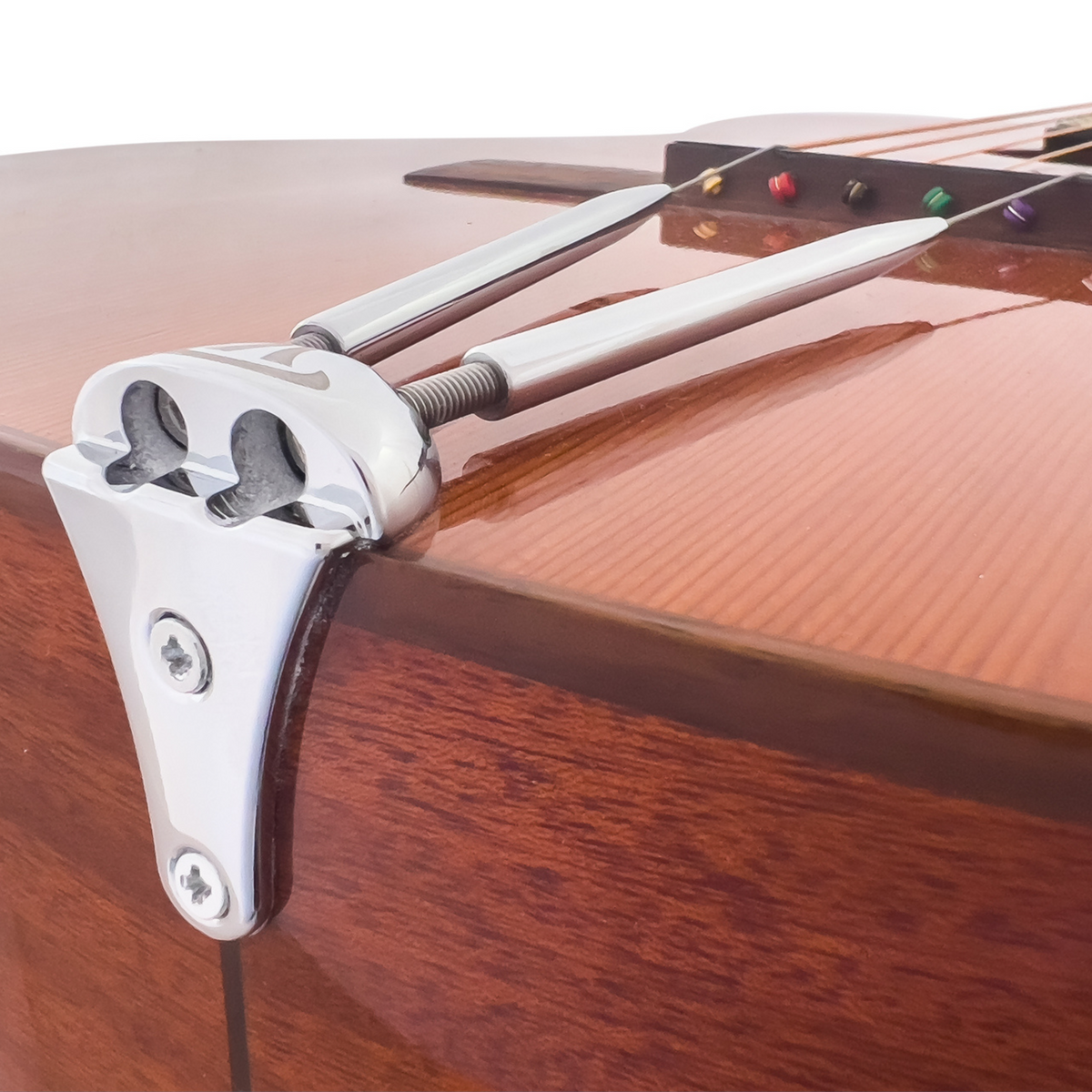
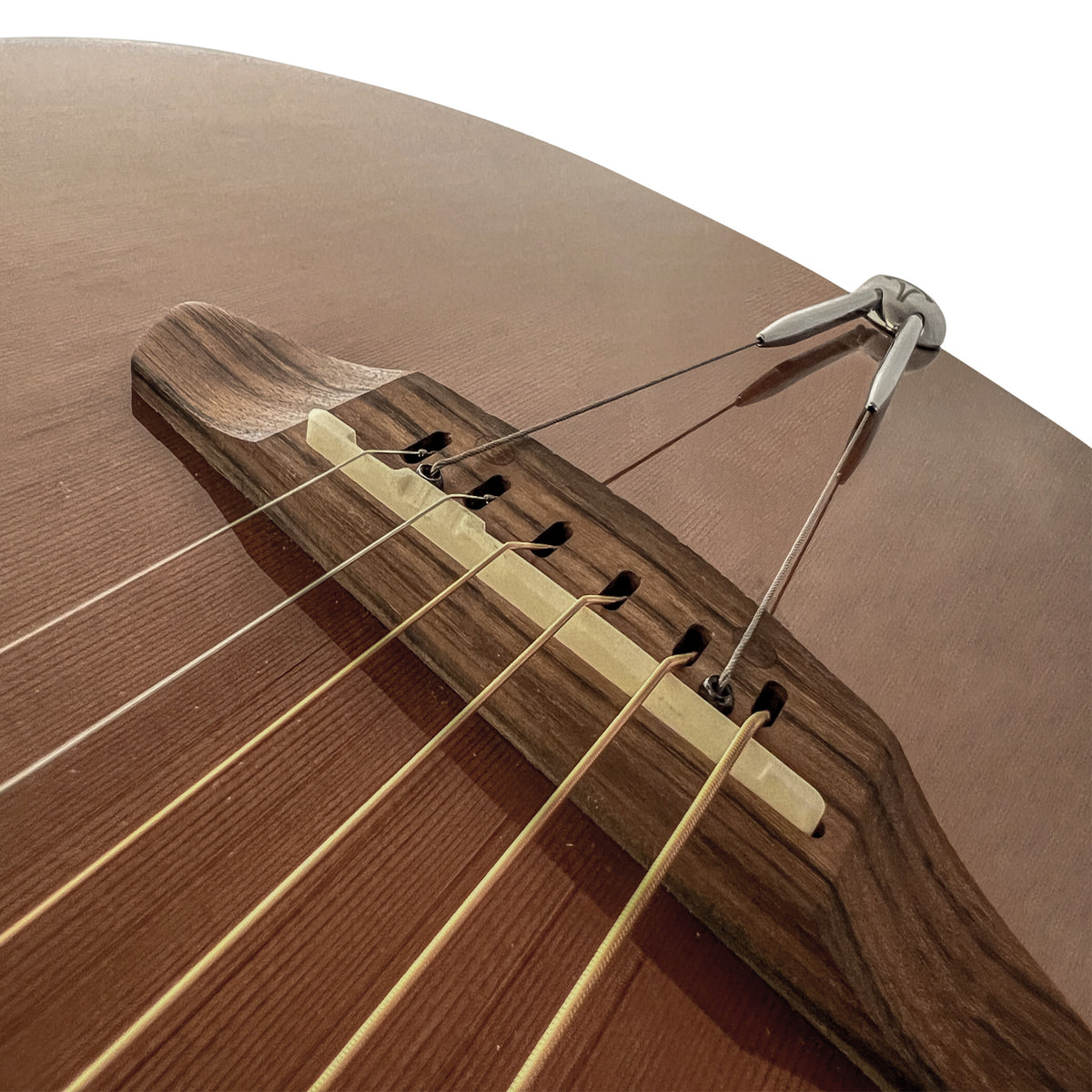
Their description of what the top is doing without it is the sharpest sentence anyone in this industry has written: the soundboard has been acting as a structural shear panel. It is not a speaker. It is a wall, holding the instrument together, and we have been asking it to sing in its spare time. Their own inventor calls the device a free soundboard device — free, specifically, of the need for conventional bracing. A builder who works with it put it perfectly: it let him begin to explore what a soundboard might sound like without all that wood attached underneath.
Read that against everything I have argued and you will see why I light a candle for these people. The top of an acoustic bass guitar is stiff because it is holding the high tension steel strings on. Stiff tops do not radiate low frequencies. Take the tension off and you can build light, and light is the whole game down where we live.
But here is their coup de grace: they realized that their innovation wouldn’t help much on an already overbraced steel string guitar or acoustic bass guitar. But nylon string classical guitars are more lightly braced as the softer strings put far less tension on the instrument — so they thought, why not put steel strings on a classical guitar once the load has been mitigated by the turbo tail? The results were astonishing: Cheap Cordoba classical guitars suddenly sounded like \$10,000 boutique steel string instruments.
And they did not stop at guitars. They went after the bass problem directly. Their own materials name the disease precisely: acoustic bass guitars get lost in ensembles because their soundboards are forced to carry immense tension from thick, high-mass strings, which limits how freely the top can vibrate. So they converted classical guitars into short-scale acoustic bass guitars. (which if you are paying attention solves two problems at once and sneaks the third in the back door). Then they went and proved it in the hardest room available. They have been taking converted Córdoba classical guitars to Wintergrass for years — a bluegrass festival, with hallway jams full of banjos and flat-picked dreadnoughts and people who have every reason to be skeptical of a converted nylon-string guitar — and they have the footage of the skeptics nodding. One of their Wintergrass testimonials is a single sentence that any acoustic bassist will feel in their chest: I can hear every note, even in a loud room.
Wintergrass Video Here
That is the campfire test, passed in public, on purpose, by people who set out to pass it.
What they got right by luck, and never mention
Here is the part I cannot let go of.
The strings on those conversions are nylon-core roundwounds — Gold Tone™ silver-plated copper over a synthetic core — and as far as I can tell they use them for the most mundane reason imaginable: that is what is commercially available in that scale length. It was not a thesis. It was what was on the shelf.
And it is doing half of their work. As far as I know they are unaware of this.
Go through their marketing, their pages, their demo videos. The tailpiece gets all the credit, and the tailpiece deserves a great deal of it. But nowhere have I found anyone on that side of the fence saying that the string core is why any of it is audible — that a steel-core string on that same converted Córdoba would put the inharmonicity back, raise the centroid, and smear the low notes into the clang we all recognize, tailpiece or no tailpiece. They solved the top. The string solved itself, in the background, by a purchasing accident.
I say this with enormous respect, because that accident is what handed me my first proof of concept and the best acoustic bass I have ever played —possibly currently the best on Earth.
I put (almost) all of it together
I ordered a Turbo Tail immediately after watching those first videos. And, not to be outdone I decided to do the conversion on a fretless classical guitar. I found an off brand “Tario” on amazon for 159\$ and did not expect too much. And of course I couldn’t sully this passion project with zingy-ass roundwound strings — Hell no!
The roundwound wrap gives back a share of the good fortune. A ribbed metal surface raises the spectral centroid, adds finger squeak on every position shift, and injects high-frequency energy at the attack — the exact hash a synthetic core just finished removing.
But there was a problem: The black nylon UBX strings from Galli topped out at 23” scale lengths, same for their nylon core chrome flats I put on my fretless U-Bass. Then I thought of Aquila, whose “Sugar” strings hella impressed on my tenor uke to mandola conversion (that’s another obsession with it’s own story). They were loud. And lo and behold they made a sugarcane derived polymer core copper flatwound set.
The Strings and the Turbo Tail together cost more than the guitar. But once I had the parts I enlisted the fantastic Peter Tsiorba at Tsiorba guitars to do the conversion and inlay stealth fret markers. The result shocked and overjoyed me. Because everyone says the same things.
It sounds like an upright. It does.
Videos coming soon.
My hundred-and-fifty-dollar fretless classical conversion, the instrument that beat every commercial acoustic bass guitar I own — exists because Turbo Guitar demonstrated that a converted classical could be a real bass, and because the strings that happen to be sold for that job happen to be the right ones. They have no idea who I am. They do not know the instrument exists — yet — I am working on an unveiling video. But this website and that instrument would not exist without them.


Technical Difficulties
And then there’s the thing that hurts to watch in those Turbo Tail demo videos — and, frankly, in almost every video on YouTube of someone playing an acoustic bass guitar of any quality.
Go and look. In most of them, including the ones featuring genuinely accomplished bass players, the player is using free strokes with the fingertips: the light, economical, amplified-bass pluck. Sometimes worse, with the hand back near the bridge. It’s the motion a lifetime of playing through an amplifier teaches you. The result is a clicky, bright, thin sound that throws away the very gains the nylon-core strings and the freed soundboard were built to deliver.
It drives me bananas.
Now don’t get me wrong. This player, for example, is a great musician: great time, impeccable note choice, soloing expertly through the changes. If we’re being honest, he’s a far better musician than I am. But he is not getting a good sound out of that instrument, and I don’t think that’s a controversial or unkind thing to say. His technique would be perfect on an electric bass through an amp. Here, listen to it: bright, thin, and at times it sounds as if he’s using his fingernails, which to me is nails on a chalkboard. His right hand is working like a notch filter, scooping the meatiest part out of every note.
On an instrument with no amplifier, that technique throws away most of the gain. I’ll explain exactly why below, at length, because it turns out to be at least half of this whole problem — and the half nobody talks about. A freed soundboard, low-inharmonicity strings, a body that can finally move — and then the note gets put into it softly, sideways, with a fingertip, back by the bridge. It’s like building a Steinway and playing the whole concert with the soft pedal held down.
Now listen to this player, who has a good rest-stroke pluck, holding his own at full volume against a fiddle, a guitar, a mandolin and a banjo. Same instrument — I mean it’s literally the same instrument — completely different result. And imagine him on a fretless with a good set of flats!
Which brings me to the part nobody wants to admit. The instrument I’ve wanted my whole adult life might be wasted on most players.
I’m not speculating. More times than I can count, I’ve been playing my U-Bass, my Martin or the Tario when another bassist walks up astonished. Wow, that little thing is loud. Are you hiding an amp? I’ve never heard an acoustic bass guitar that loud. Can I try it?
So I hand it over — good players, monster players — and there it is. Plucking back by the bridge. Free strokes. Palm muting.
Then they hand it back with a shrug.
The hardest case is the palm-muted approach that’s become so popular in recent years: the side of the hand resting on the strings near the bridge, thumb and finger rolling gently over the strings. Brilliant electric players like Janek Gwizdala or Dominique Di Piazza do this to get a thuddy, upright-like decay out of a roundwound electric bass. On the instrument it evolved on, it’s a genuinely cool and useful technique.
But think about what it actually is. It’s Leo Fender’s factory foam mute, moved from under the bridge cover into the player’s hand. A whole generation of bassists spent years training their right hand to make a steel-strung electric sound like an acoustic instrument — and got so good at the impression that when a real acoustic instrument arrives, the hand mutes that too. They learned to fake the acoustic so well that they can’t play the thing they were faking.
Which brings me to the hardest part of all.
You Will Almost Certainly Have to Change Your Technique
There is no way to sugarcoat this.
Genuinely acoustic instruments make you pay your dues. You will have to adapt your playing technique to get the best tone and volume out of them. You can’t just turn up the amp, roll off the tone knob, or buy another pedal to get the sound you want.
So be honest with yourself. If you want to play exactly the same way, and exactly the same lines, as you do on electric bass, then a real acoustic bass may simply be a waste of money and wood for you. You’ll probably be happier with a U-Bass and a small battery-powered amp. No shame in that. The Phil Jones X4C is fantastic.
But before you dismiss me as a curmudgeon, I need to tell you about a harmonica.
During my instrument carousel years — the long stretch where I bought and abandoned a violin, a tuba, a melodica, an esraj, a euphonium and an oud, each seized with total conviction and set down within the year — I ordered a very expensive custom harmonica from Seydel, the German firm, one of the few that will build to a tuning you specify. I had it made in a diminished tuning, symmetrical, so that any lick transposes to any key by sliding your hands. I had decided this was the perfect machine for gypsy jazz.
I practiced it diligently for months, and I could not get the notes to speak. Not the difficult ones — notes all over the instrument came out choked and thin, or came out late, or simply did not sound. I checked my breathing. I checked my embouchure. I checked it for debris. Then I got angry, packed it up, shipped it back to Germany, and included a polite but firm letter explaining that the instrument I had paid a great deal of money for was defective.
I expected a form letter. What I got was a phone call from one of their engineers. He was not rude. He was something worse than rude. He was completely certain. He told me there was nothing wrong with the harmonica, that they had tested it, and then he said, flatly, in the manner of a man who has had this conversation many times and does not enjoy it:
“I am quite sure it is your technique.”
He was right. I was playing too hard. A harmonica reed is a small piece of brass that has to be free to swing at its own amplitude, and too much air pressure makes it bind, choke, arrive late, or refuse to sound at all. Every symptom I had diagnosed as a defect was me overdriving a system that needed to be left alone.
Hold that story, because I’m going to need it in a moment. But first its mirror image, which happened to me on the other side of the same mistake.
I have had one semester of bass lessons in my life. One. Everything else is self-taught, for better and for worse. That semester was in the jazz department at the University of New Mexico, with Dr. Mark Tatum, on upright, and somewhere in the first few weeks he watched me approach the strings the way I always had — fingertips, dainty, precise, the technique a lifetime of amplified playing had built into my hands — and he reached over and swatted my hand away from the instrument.
“That’s how you pick your boogers,” he said. “It’s not how you play the bass.”
Then he showed me the right way. Flesh. Weight. The side of the finger, the whole arm committed, driving the string instead of picking at it. The change in depth and volume was not subtle and it was not gradual. It was immediate, it was enormous, and it reorganized my understanding of what I had been doing wrong for years. I’ve played that way ever since — on the upright, on the acoustic bass guitar, and on the electric too, where it turns out to sound better as well. It looks a little different on each instrument, but the principle is the same one classical guitarists have taught for two centuries: the rest stroke, which they call apoyando.
If you don’t believe me, watch John Patitucci demonstrate it on upright.
Now put the two lessons side by side, because between them they describe the entire problem. A German engineer told me I was driving an instrument too hard. An American teacher told me I was driving one too softly. Both were saying the same thing: you have brought the wrong technique to this machine, and the machine is not going to meet you halfway.
The amplified right hand I described above is a rational adaptation to an electric bass through a rig. On an acoustic instrument it’s a catastrophe, because an acoustic instrument’s entire output is the energy your hand puts into the string. There is no amplifier.
Whatever you fail to put in is simply not there.
And here is the thing that should embarrass all of us: every other instrument on earth charges an entry fee, openly, and nobody complains.
Take up the violin and you’re signing on for years of screeching and sawing while you learn to balance weight against speed against contact point — and, crucially, while you learn to play in tune. Nobody proposes putting frets on a violin. Nobody proposes putting frets on a cello, or an upright bass. The absence of frets is understood to be part of the instrument, and learning to find the note is understood to be part of the job. Take up the trumpet or the flugelhorn and you will learn to buzz your lips correctly or you will produce no sound at all — not a bad sound, no sound. The instrument declines to participate until you’ve paid.
So why is the bass exempt? Only because we let it be. We got amplifiers, and amplifiers let us skip the dues, and then we forgot there had ever been any.
And while we’re paying dues, there’s a second one hiding inside the first. Learning to play a fretless instrument in tune forces you to train your ear. You can’t play in tune if you can’t hear the difference between sharp and flat, and the instrument will tell you, every note, whether you can. Raised on frets, tablature and amplifiers, a lot of us learned to be finger-wigglers rather than listeners. The fretless acoustic bass is a very efficient cure.
On an acoustic bass guitar, you are the volume knob. Your right hand is the EQ. Where you pluck is the tone control, how hard you pluck is the gain, and what part of your finger touches the string is the high shelf. There is no other signal path.
Which means the technique is not an accessory to the design. It is a clause of it.
So here is the bare minimum you have to master if you want volume, warmth and depth from an acoustic instrument. Otherwise — stick with amps and pickups.
Rest strokes. Apoyando — from apoyar, to lean, to rest, to support. The finger plucks through the string and comes to rest against the next one, instead of curling up and clearing it. Three things follow, and this instrument needs all three.
First, direction. A string can vibrate in any plane, and the plane matters: a string swinging parallel to the soundboard pushes the bridge sideways, which the top can barely convert into sound, while a string swinging perpendicular to it drives the bridge straight into the top. The rest stroke’s path aims down toward the soundboard, and it tends to set the string vibrating at a steeper angle, with more of its motion perpendicular to the top. Jim Woodhouse, in his online Euphonics, describes the result as a louder and fuller sound.
Second, amplitude. Because the finger is supported through the whole motion and lands against the next string, you can displace the string much further without losing control or accuracy. More displacement is more energy in the string, and on an instrument with no amplifier, that’s the whole ballgame.
Third, the octave. A string plucked hard actually stretches as it swings, which modulates its tension twice per cycle and pumps energy into a frequency exactly twice the fundamental. The string generates its own octave, and that octave grows with the square of the amplitude. Which means a bigger stroke doesn’t merely make the note louder — it manufactures more of the exact harmonic the listener’s ear uses to hear the note as low.
Now an honest word about the first of those three, because the research doesn’t entirely agree with itself — and neither does your hand. Thomas Rossing’s The Science of String Instruments notes that the rest stroke induces only slightly more perpendicular motion than a free stroke, and that the two differ less in this respect than guitarists tend to believe. My own reading is that the amplitude and the commitment matter at least as much as the angle. And the feel can mislead you: when you do it right, it may feel as though you’re pulling the string sideways, or pushing through it toward the next string, rather than driving it down into the top. What you feel and what the string actually does won’t always match. That’s exactly why it’s worth watching good players and matching their motion rather than trusting a description — including mine. I’m planning to measure rest strokes against free strokes on the same instrument, and I’ll report what the microphone says.
Done correctly, the harder you play, the deeper the bass gets — measurably, right up to the point where you start getting buzz or the string’s own natural distortion. And none of it requires strain. All of this can and should be done relaxed, with no unnecessary tension anywhere. Watch me here: loud roots, a flashy solo, real volume, and I’m not working hard or straining at all.
Pluck position. Move away from the bridge, toward the neck. The harmonic content of a note is set by where your hand lands as a fraction of the string’s length, which is why an electric player’s habitual spot near the bridge produces a bright, edgy attack, and why the upright player’s spot up at the end of the fingerboard produces the sound everybody wants. But don’t simply copy the upright. On an acoustic bass guitar, the end of the fingerboard sits close to the middle of the string, and the middle of the string is a dead spot for the second harmonic. Pluck there and you suppress the very partial you’re trying to strengthen, and the note goes hollow — plenty of fundamental, oddly gutless. Hunt for the spot where the note is fattest without going floppy. Your ears will find it in thirty seconds once you know to look.
Flesh, not fingertip. The difference is not subtle. Even a few millimetres more finger into the string makes an enormous difference — though too much and the string catches. I find I use a bit of the side of my finger. A hard, small contact point injects high frequencies at the attack. A broad, soft one doesn’t. Watch Ray Brown play the upright. Jazz bassists worked all of this out empirically, by ear, long before anyone thought to call it the spectral centroid.
In Summary and Snark.
If I’m allowed a small ration of ego: as far as I can tell, nobody has asked that question. Not in fifty years of acoustic bass guitars, not in the forums, not in the trade press, not in any patent I have read. Builders have asked how to make a bigger box, how to brace a top that will not fold, how to get a piezo to sound less like a kazoo, how to move units. Nobody has asked what an unamplified bass body should be tuned to once you stop pretending it can radiate the fundamental and once you realize that the goal is to line up the harmonics with a nylon core and pull every psychoacoustic lever possible to get the bass to make people infer the missing fundamental.
If I am wrong about that, I would genuinely love to be corrected in public.
And I do not think it is because everyone before me was less clever. It is because of what each of them actually wanted.
Leo Fender wanted to sell instruments to guitar players. Ernie Ball wanted a product that matched his catalog. Taylor wanted a bass out of a small-guitar platform. Kala wanted a novelty that killed through an amp. MTV wanted something that photographed as wood. Turbo Guitar is the honourable exception and even they were answering a different question — theirs was about the soundboard, and it was a good question, brilliantly answered. Every one of those is a legitimate goal, and a piece of the puzzle I have assembled — and not one of them requires the instrument to be audible in a room with no electricity in it. You can satisfy all five without ever once asking where the air resonance should sit, because nobody is ever going to check.
I am not smarter than these folks. Andy Powers is a better luthier than I will ever be. I just want something none of them really cared about: a bass I can actually play around a damn campfire and be heard. And it turns out that what you want determines which questions are even visible to you. Ask “how do I sell this” and the box is a cost and a silhouette. Ask “how do I get heard at a fire with two guitars and a singer” and the box becomes a filter with a tuning, and that tuning becomes the most interesting number in the instrument.
That is the whole difference between this manifesto and the last fifty years. Not better physics. The physics has been sitting in Fletcher and Rossing the entire time, and in Helmholtz before that.24 Just a different thing wanted, badly enough and for long enough to keep asking beyond the point where a manufacturer would have stopped.
Which leaves a practical problem, and it is the one that has kept this field frozen even when somebody does stumble into the right answer. Nobody can tell. There is no way for a builder to demonstrate that an instrument works, no way for a buyer to check, and no way for any of us — me included — to be proven wrong.
Fifty years of adjectives. That is the next thing that has to go.
Are There No Standards Anymore? No, There Never Were Any Standards
Here is a game you can play this afternoon. Go and read the marketing copy and the reviews for every acoustic bass guitar currently on the market, and try to find one single claim about volume that could be proven wrong.
You will not find one. What you will find is adjectives.
Powerful. Punchy. Responsive. Rich. Warm. Incredible acoustic tone. Surprisingly robust for its size. Plenty of volume. Great projection. Thumping. Surprisingly loud — and that phrase, surprisingly loud, turns up so consistently across this category that it has stopped being a description and become a genre.
Every one of those is unfalsifiable. Not dishonest, necessarily. Just empty. There is no number attached, no method, no reference instrument, no distance, no stroke, nothing another person could repeat. If I tell you my bass is punchy and you tell me it isn’t, neither of us has said anything, and we both go back to the forum to argue about it for another fifteen years.
And it is not a bass problem. Go look at acoustic guitar reviews and you will find a two-hundred-dollar parlor guitar described as surprisingly loud, and able to keep up with a dreadnought for projection and volume. Maybe it does. There is no way to know, and no way for the next reader to check.
The most honest sentence I have found anywhere in this category came from an ordinary owner rather than a manufacturer, describing a Fender acoustic bass: loud enough to play with one acoustic guitar, but not enough without an amp for a larger group. That is a real claim. It names the ensemble, it names the limit, and it could be wrong. One line from a civilian on the internet is more rigorous than fifty years of catalog copy.
And in the absence of any measurement at all, buyers do what humans always do when the information is missing. They substitute a proxy. In this case, price. I have watched people reason, in public and in complete sincerity, that the more expensive instrument must be the louder one — which, given everything argued above, is very nearly an inverted indicator. The most expensive acoustic bass guitars are the big steel-strung ones. I have spent three thousand dollars on instruments that lost a shootout to a hundred-and-fifty-dollar classical with a tailpiece bolted to it.
Price as a proxy for volume. That’s where fifty years of no standards leaves the consumer.
Everyone else solved this
The maddening thing is that this is not hard, and every adjacent industry did it decades ago.
Loudspeakers are the obvious comparison, because a loudspeaker and an acoustic bass guitar are doing the same job: converting energy into radiated sound. And no, the industry does not just infer loudness from wattage — watts are what goes in, not what comes out, and a speaker company that only published wattage would be laughed at.
What they publish is sensitivity. Under IEC 60268-5 you drive the loudspeaker with band-limited pink noise at a voltage set by the square root of its rated impedance, measure the sound pressure level, and reference it to one metre. Out comes a number in decibels. Two speakers, two numbers, and a buyer can compare them without listening to a single adjective.
Even that has known limits, and the limits are instructive for us. Sensitivity only predicts output for a signal of a specific bandwidth and spectral content, and two speakers with identical sensitivity ratings can produce different sound pressure levels from the same signal if their frequency response limits differ. Which is our exact problem stated in someone else’s vocabulary. One number describing a whole spectrum is not enough when the interesting part of the spectrum is the part the device struggles with.
But notice what that objection is. It is an argument about which measurement, made by people who all agree there must be one. That conversation has never happened about acoustic bass guitars, because the first one never did.
Perceived loudness is psychological, and it has standards too
Now the part that matters most for us, and the part I expect resistance on.
Loudness is not a physical quantity. Sound pressure is physical; loudness is what a nervous system does with it. A forty-one hertz tone and a thousand hertz tone at identical sound pressure are nowhere near equally loud, and the entire back half of this argument has been about the consequences.
You might think that makes it unmeasurable. It does not. Psychoacousticians have been quantifying perceived loudness since the 1930s, and the units exist: the phon, which is loudness level referenced to a thousand hertz tone, and the sone, where one sone is defined as the loudness of a forty decibel tone at one kilohertz. Rough rule of thumb from that work: it takes about ten decibels to produce a perceived doubling of loudness in the middle of the spectrum, and about six down where the bass lives.
And these are not academic curiosities. They are published international standards. ISO 532-1 standardizes the Zwicker method.23 ISO 532-2 standardizes the Moore-Glasberg method, which computes loudness by simulating the excitation pattern along the basilar membrane, passing the signal through a bank of auditory filters on a scale derived from actual notched-noise masking experiments, then integrating the result. And ISO 532-3, published in 2023, extends it to time-varying sounds and explicitly covers musical sounds and impacts.
Time-varying. Musical. Which is to say: a plucked note that decays. Which is to say: exactly the thing we need to measure and nobody has.
I want to underline whose name is on that standard, because the circle closes here. Brian Moore is the same researcher whose work on pitch and the dominance region I have been leaning on all the way through — the finding that the ear weighs the low harmonics rather than the fundamental.15 The man who helped establish which partials your ear actually uses to hear a bass note also co-authored the international standard for calculating how loud a sound seems. Both halves of this argument are sitting in the same person’s bibliography, and no instrument maker has ever opened it.
And if you think a perceptual standard is too fuzzy for commerce, consider that broadcast television solved its own loudness war exactly this way. Commercials were blasting out of programmes because everyone was measuring peak level, which is physical, instead of perceived loudness, which is not. The fix was a psychoacoustically weighted measurement — the one that reads out in LUFS — written into law and regulation. An industry with billions at stake decided that perceived loudness was measurable enough to legislate. A guitar company can manage a number on a spec sheet.
So here is the standard
The FreeBass Standard exists because I got tired of arguing with adjectives.
Its design principle is simple: every clause has to be falsifiable, and every clause has to be testable by a working luthier with a phone, a tuner and a quiet room. A standard that requires an anechoic chamber is a standard that will never be used, and a standard nobody uses is another adjective.
The clauses fall into four groups.
The string. Not a materials rule — a performance rule, because a rule that says “no steel” is both unenforceable and wrong at the edges. Instead: inharmonicity measured at the eighth partial must fall within a stated tolerance in cents, and stopped-pitch rise at a defined action height and fingerboard position must stay under a stated number of cents. A superb rope-core steel string can pass the first test. It cannot pass the second at fretless action. The measurements do the discriminating, not my prejudices.
The body. The air resonance must sit below the second harmonic of the instrument’s lowest string, with margin — for a standard four-string bass, comfortably under 82 Hz. The first coupled top resonance should land among the third harmonics. Both are measurable with a free phone app and a tone generator in about ten minutes.
The structure. String tension terminates at the tail block, not in the soundboard. Stated as a function rather than a construction, so a tailpiece, a cable-through-bridge hybrid, or something nobody has built yet can all satisfy it.
The output. This is the one the whole essay has been building toward, and it is the clause I most want other people to argue with me about. Not decibels alone — a loudness figure, computed by a published perceptual method, for a defined stroke at a defined distance, alongside the spectral centroid and the ratio of the second harmonic to the fundamental. Three numbers that together say what “deep” and “loud” and “projects” have been failing to say since 1972.
And then one clause that is not about the instrument at all: the technique. Rest strokes, pluck position, flesh contact. Because an instrument that meets every other clause will still disappoint a player whose right hand was trained on an amplifier, and a standard that ignores the player is measuring half the system.
The point of a standard
A standard is not a rule about how to build. It is a shared way of being wrong in public.
Right now, nobody in this field can be proven wrong, which is why nothing has improved in fifty years. Every claim is an adjective, every disagreement is a matter of taste, and every buyer is left guessing from the price tag. Publish numbers and methods and suddenly there is something to falsify — including everything I have argued here. If my instrument fails my own standard, I want that to be a fact somebody can establish without my permission.
That is the whole offer. Not trust me, it’s punchy. Here is the number, here is how I got it, go and check.
He who hath an ear, let him measure.
The Future of Acoustic Bass
So let’s build the thing.
Everything here converges on a single design brief, and it is worth stating in one breath before we get to the wood: stop trying to radiate a note the box cannot produce and the ear barely registers, and spend every available resource on the harmonics the listener actually uses to hear it. Lower the inharmonicity so the evidence agrees with itself. Lower the centroid so the sound reads as deep. Put the body’s resonances where the second and third harmonics live. Take the structural load off the top so it can move. And then hand the instrument to a right hand that knows how to drive it.
Five clauses. Not one of them is expensive. Not one of them requires a material that didn’t exist in 1972. And in combination they produce an instrument that is the opposite, feature for feature, of everything this industry has built for fifty years.
The instrument
Strings: synthetic core, always. This is the decision everything else hangs from, and it is not a preference. A nylon, sugar-bioplastic or polymer core has a bending stiffness forty to a hundred times lower than steel, which collapses inharmonicity on precisely the two strings that need it most. High internal damping kills the partials above the fifth, leaving the dominance region alone to carry the note and dropping the spectral centroid without touching a single low frequency. And compliance means the string displaces far enough under a real stroke to generate its own octave. One decision, three of the five clauses satisfied. Flat wraps where you want maximum depth, round where you want articulation, and the choice is genuinely musical rather than structural — which is the point. Only steel cores are off the table.
Scale: short, because the strings allow it. Chubby is specified at twenty-five and a half inches of vibrating string — ordinary guitar scale — and the honest reason the spec has any flex in it at all is string availability. Anywhere from about twenty-three inches up to twenty-five and a half works acoustically; what actually decides the number is which synthetic-core sets exist in that length at a sensible tension, and that is a smaller catalogue than it ought to be. Short scale is very slightly worse for inharmonicity in isolation and wins overwhelmingly in practice: it forces the right strings, it raises string impedance so more energy transfers into the top instead of ringing uselessly in the string, it moves the player’s hand deeper into the string as a fraction of its length, and it stops the neck behaving like a long floppy beam that eats the note. Note where the reference instrument sits — the guitarrón, the loudest portable unamplified bass on earth, runs at ordinary guitar scale too, and so does the hundred-and-fifty-dollar classical that started all this.
No frets. Partly for intonation freedom, mostly for the centroid: every fret is a metal-to-metal contact that injects high-frequency energy at exactly the moment the ear is deciding what it heard. The upright has none. The guitarrón has none. There is a reason.
A tailpiece, and the top set free. This is the piece I proved to myself before I understood why it worked. On a conventional pin bridge, the soundboard is a structural shear panel holding a hundred and forty to a hundred and ninety pounds of pull, which is why steel-string tops are braced like roof trusses and why they cannot move. Run the tension back to the tail block instead and the top’s only remaining job is to convert string motion into sound. On the prototype, a carbon coordinating rod ties the tail block to the heel block and carries the entire string load through the body rather than across the soundboard, which means the top can be built to a thickness no braced instrument would survive: Port Orford cedar at two millimetres, with a single transverse brace. Not a bracing pattern. One brace.
A box tuned to the harmonic grid, not to the fundamental. This is the number nobody in fifty years has bothered to specify. The prototype — Model One, which everyone calls Chubby — runs about twenty-six litres of air in a body with an eighteen-inch lower bout and a compound wedge depth from five inches at the treble side to seven at the bass, which puts the air resonance around seventy-three hertz bare, with duct inserts to bring it into the mid-to-high sixties. The target is a comfortable margin below eighty-two hertz, the second harmonic of the low E, so that partial radiates from the strongest part of the instrument’s response instead of falling off the cliff. The top’s first mode goes up among the third harmonics. And we stop there, deliberately: chasing anything lower buys notes the ear discounts anyway, at a cost in size and weight that makes the instrument you cannot carry — which is the whole failure mode of the Earthwood.
And nothing in the way of the right hand. No pickguard, no golpeador, nothing crowding the zone between the soundhole and the end of the fingerboard, because that is where the player needs to land and every square inch of decoration there is a decision made for a photograph.
Four strings, E to G. Never anything below E1. Above G2 is open — a high C, or the full six — but that’s taste, not physics. James Island is building it. There is a smaller sibling coming for the trail, called Bass Camp. And the whole recipe was proved on a hundred-and-fifty-dollar fretless classical guitar with a tailpiece and sixty dollars of strings, which still outperforms every commercial acoustic bass guitar I own.
That’s the instrument. Now the harder half. And it is at least half of what it takes to get genuine bass out of a portable instrument. That half is YOU.
What it’s for
Put it all together and here is what you get.
An instrument you can carry on your back, unzip at a campfire, and play with enough physical authority that the person across the fire feels the root before they’ve identified it. No cord. No battery. No apology. A box tuned to the harmonics a nervous system actually consults, strung with a material chosen for how humans hear rather than for how a pickup listens, with the soundboard free of everything except its one job, and driven by a right hand that has paid its dues the way every other acoustic musician on earth has always paid them.
And I know exactly who it’s for, because I’ve spent thirty years being the asterisk on the word acoustic.
It’s for the bluegrass jam in the hallway at a festival, and the Django tune in the corner of a pub where nobody came to listen. It’s for the Bulgarian session lurching through eleven-eight, and the oud player whose quiet, ancient instrument will expose a loud bass as vulgar and a weak one as absent. It’s for living rooms and ceremonies and circles where somebody’s song is a prayer and you can hear the extension cord. It’s for the trail up to the hot springs, where my friends walked in with guitars on their backs and I sat in the water twiddling my thumbs, the only musician there without a voice, because the industry had never built the thing I needed.
That’s the whole brief, honestly. Let the bassist come.
But I’d be lying if I said that was the interesting part. The interesting part is what I can’t predict.
Instruments are feral
Here is something nobody who builds things gets to control, and thank God for it.
Instruments escape. They have a will of their own, and a range far beyond anything their inventors could have pictured, and the history of music is mostly the history of designers being magnificently wrong about what they made.
Adolphe Sax built a horn to bridge brass and woodwind in military bands and orchestras. He did not build Coltrane. Leo Fender designed a customer-acquisition device so jobbing guitarists could take a bass gig on Friday night, and what came out the other end was James Jamerson rewriting what a bassline could be, Jaco Pastorius playing harmonics like a violinist, Geddy Lee and heavy metal and dub and funk — none of which existed in anyone’s imagination in 1951, all of it downstream of a radio repairman trying to sell a doubling instrument to guitar players. The loudest, most transcendent thing in rock is amplifier feedback, which everyone involved spent twenty years trying to eliminate as a defect. Roland built the TB-303 to simulate a bass guitar for lonely guitarists, failed completely, discontinued it — and a decade later people in Chicago found them in pawn shops and invented acid house out of the sound of the machine failing at its job. Trinidadians made an orchestra out of discarded oil drums.
None of those people asked permission. None of those outcomes were on a spec sheet.
Which is the real answer to what this instrument is for, and it’s the part I find genuinely thrilling. I want it for gypsy jazz. I want it for bluegrass and old-time, for Balkan tunes in limping meters, for acoustic folk music and the songs people sing together around a fire. Those are my rooms and I built it for them.
But I have no idea what happens when it gets out.
Nobody has ever handed a creative musician a portable, unamplified instrument that can genuinely hold down the bottom — not once, in the entire history of music. The upright could do the job and couldn’t travel. The bass guitar could travel and needed a wall socket. The guitarron remains trapped in Mariachi. The acoustic bass guitar promised both and delivered neither. There has never been a generation of players who grew up able to simply take the low end with them, anywhere, at no cost, with no permission and no infrastructure.
So I don’t know what they’ll do with it. I know what I’d do, and I’m the least imaginative person likely to hold one. Somebody is going to take this thing somewhere I would never have thought of, playing something I wouldn’t recognize, and when they do, the instrument will stop being mine in exactly the way instruments are supposed to.
That’s not a risk of the project. That’s the point of it.
The argument
The bass note will still be mostly assembled in the listener’s head. It always was — from the upright, from the guitarrón, from every instrument in history. That is not a flaw in the design and it is not a trick. It is how hearing works, and the whole discipline of building is just this: make the best possible case, in the register where the evidence lands, and let the mind do what minds do.
We will conjure the missing fundamental.
He who hath an ear, let him hear.
References
-
Jason Krivo Flores, “Hume in the Light of Bayes: Towards a Unified Cognitive Science of Human Nature,” Res Cogitans (2015); reissued in the International Journal of Undergraduate Research and Creative Activities 7, no. 2 (2023), doi:10.7710/2155-4838.1119. Free to read. ↩
-
Richard M. Warren, “Perceptual Restoration of Missing Speech Sounds,” Science 167, no. 3917 (1970): 392–393. ↩
-
J. F. Schouten, “The Residue and the Mechanism of Hearing,” Proceedings of the Koninklijke Nederlandse Akademie van Wetenschappen 43 (1940): 991–999; Ernst Terhardt, “Pitch, Consonance, and Harmony,” Journal of the Acoustical Society of America 55, no. 5 (1974): 1061–1069. ↩
-
John Coltrane Quintet, European tour, November 1961: Coltrane, soprano saxophone; Eric Dolphy, flute; McCoy Tyner, piano; Reggie Workman, bass; Elvin Jones, drums. Performances issued on Live Trane: The European Tours (Pablo, 2001). ↩
-
David Hume, A Treatise of Human Nature (1739–40), Book 1, Part 3, Section 14, “Of the Idea of Necessary Connexion.” ↩
-
Daniel C. Dennett, From Bacteria to Bach and Back: The Evolution of Minds (W. W. Norton, 2017); see also Dennett, “Comment on Schliesser,” Teorema 37, no. 3 (2018): 181–185. ↩
-
Hermann von Helmholtz, Handbuch der physiologischen Optik (Leipzig: Voss, 1867); English translation, Treatise on Physiological Optics, trans. J. P. C. Southall (Optical Society of America, 1924–25). ↩
-
The phrase is standard in the predictive-processing literature. See Andy Clark, Surfing Uncertainty: Prediction, Action, and the Embodied Mind (Oxford University Press, 2016), and Anil Seth, Being You: A New Science of Consciousness (Dutton, 2021). ↩
-
Meir Shashoua and Daniel Glotter, “Method and System for Enhancing Quality of Sound Signal,” U.S. Patent 5,930,373, issued July 27, 1999; Daniel Ben-Tzur and Martin Colloms, “The Effect of MaxxBass Psychoacoustic Bass Enhancement on Loudspeaker Design,” Audio Engineering Society, 106th Convention (1999). ↩
-
Hermann von Helmholtz, Die Lehre von den Tonempfindungen als physiologische Grundlage für die Theorie der Musik (1863); English translation, On the Sensations of Tone, trans. Alexander J. Ellis (1875). ↩
-
Jim Woodhouse, Euphonics: The Science of Musical Instruments, euphonics.org. ↩
-
Harvey Fletcher, “Normal Vibration Frequencies of a Stiff Piano String,” Journal of the Acoustical Society of America 36, no. 1 (1964): 203–209. ↩
-
O. L. Railsback, “Scale Temperament as Applied to Piano Tuning,” Journal of the Acoustical Society of America 9, no. 3 (1938): 274. ↩
-
Harold A. Conklin Jr., “Generation of Partials Due to Nonlinear Mixing in a Stringed Instrument,” Journal of the Acoustical Society of America 105, no. 1 (1999): 536–545. ↩
-
Brian C. J. Moore, Brian R. Glasberg, and Robert W. Peters, “Relative Dominance of Individual Partials in Determining the Pitch of Complex Tones,” Journal of the Acoustical Society of America 77, no. 5 (1985): 1853–1860; Brian C. J. Moore, An Introduction to the Psychology of Hearing, 6th ed. (Brill, 2012). ↩↩
-
John M. Grey and John W. Gordon, “Perceptual Effects of Spectral Modifications on Musical Timbres,” Journal of the Acoustical Society of America 63, no. 5 (1978): 1493–1500; Emery Schubert and Joe Wolfe, “Does Timbral Brightness Scale with Frequency and Spectral Centroid?” Acta Acustica united with Acustica 92, no. 5 (2006): 820–825. ↩
-
Allan Slutsky, Standing in the Shadows of Motown: The Life and Music of Legendary Bassist James Jamerson (Hal Leonard, 1989). ↩
-
Taylor Guitars, “GS Mini Bass,” product story featuring Andy Powers, taylorguitars.com: 23½-inch scale; custom nylon-core strings with phosphor bronze wrap developed with D’Addario, which Taylor states are the only strings that will work on it. ↩
-
Helmut Fleischer and Tilmann Zwicker, Dead Spots: Zum Schwingungsverhalten elektrischer Gitarren und Bassgitarren, Beiträge zur Vibro- und Psychoakustik 1/96 (Universität der Bundeswehr München, 1996); Helmut Fleischer, “Dead Spots of Electric Guitars and Basses,” paper 5aMUb6, joint ASA/EAA/DAGA meeting, Berlin, March 1999. ↩
-
Tony Bacon and Barry Moorhouse, The Bass Book: A Complete Illustrated History of Bass Guitars (London: Balafon, 1995; rev. ed., Backbeat, 2008). ↩
-
Ernie Ball, Inc., company history, quoting Ernie Ball on buying a guitarrón in Tijuana. The Earthwood acoustic bass, developed with George Fullerton, was introduced in 1972. ↩
-
Violent Femmes, Violent Femmes (Slash Records, 1983), with Brian Ritchie on acoustic bass. ↩
-
ISO 532-1:2017, Acoustics — Methods for Calculating Loudness — Part 1: Zwicker Method; ISO 532-2:2017, Part 2: Moore-Glasberg Method (International Organization for Standardization, 2017). ↩
-
Neville H. Fletcher and Thomas D. Rossing, The Physics of Musical Instruments, 2nd ed. (Springer, 1998). ↩